
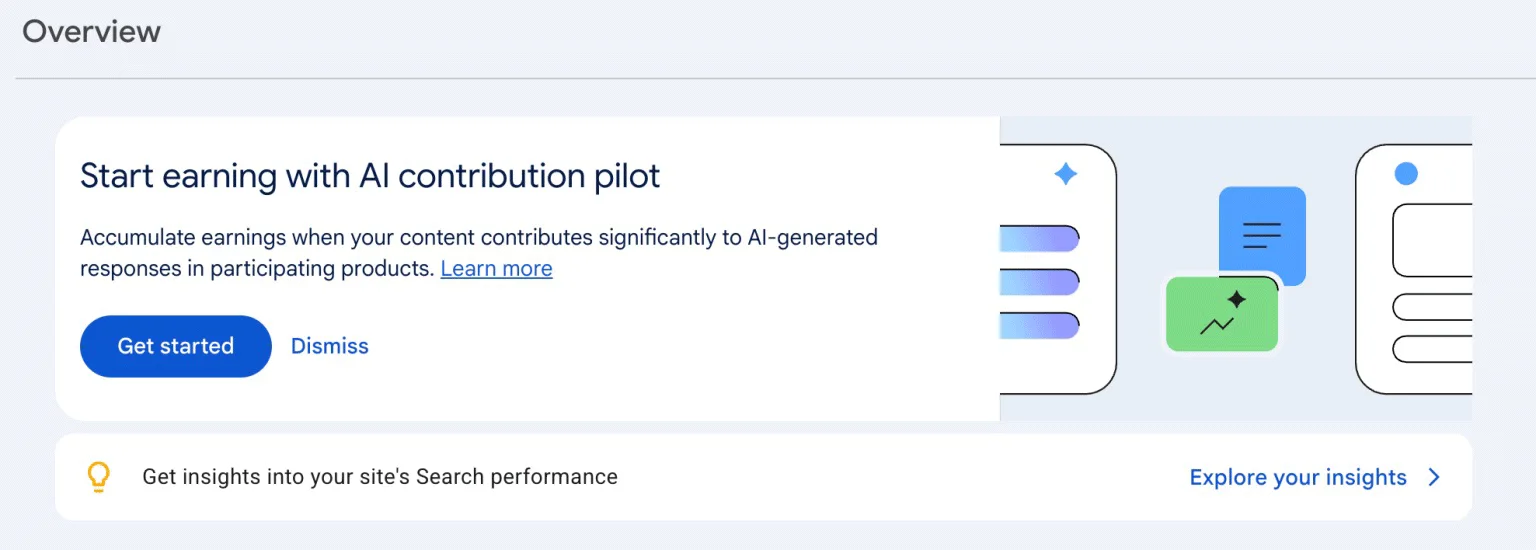
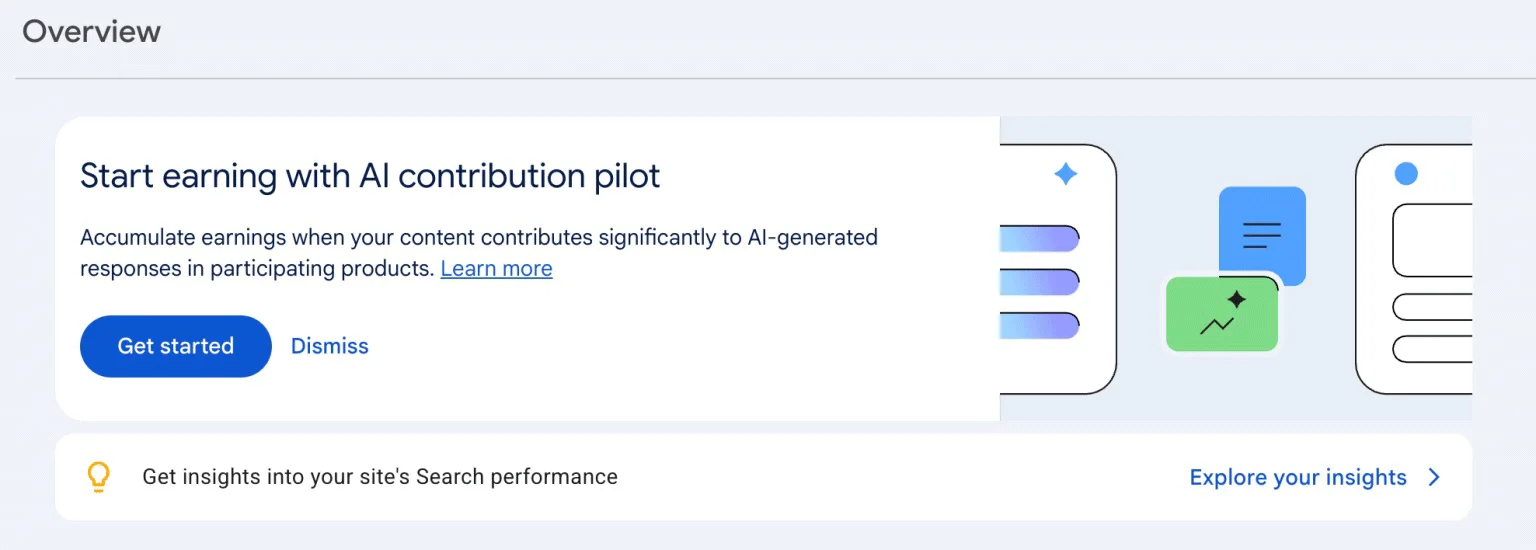
Google is testing direct payments to selected publishers when their content makes a significant contribution to an AI-generated answer. The invitation-only experiment, called the AI Contribution Pilot, covers participating Google products including Gemini, AI Overviews, and AI Mode.
The pilot creates a new exchange between Google and the open web. Traditional search rewarded publishers indirectly by sending visitors to their pages. Google is now testing whether a publisher should receive money when its reporting or specialist knowledge improves an answer, even when the user does not click through.
That change sounds simple. The details are not.
Google has not disclosed its payment formula, eligibility rules, standard rates, list of participants, or expansion timeline. Publishers inside the test reportedly see monthly earnings in Google Search Console, but they do not receive enough data to independently connect each dollar to a specific article or AI response.
Here is what Google has confirmed, what industry reporting has uncovered, and what remains speculation.
What is the Google AI Contribution Pilot?
The Google AI Contribution Pilot is an early-stage commercial program that pays selected websites when their content materially improves the freshness or factual accuracy of an AI-generated response.
Google publicly described the underlying idea on June 18, 2026. The company said it was piloting a new partnership model for websites whose content meaningfully contributes to the freshness and factuality of generative AI responses through grounding. Google did not name the program or disclose the payment system in that announcement. Google Public Policy
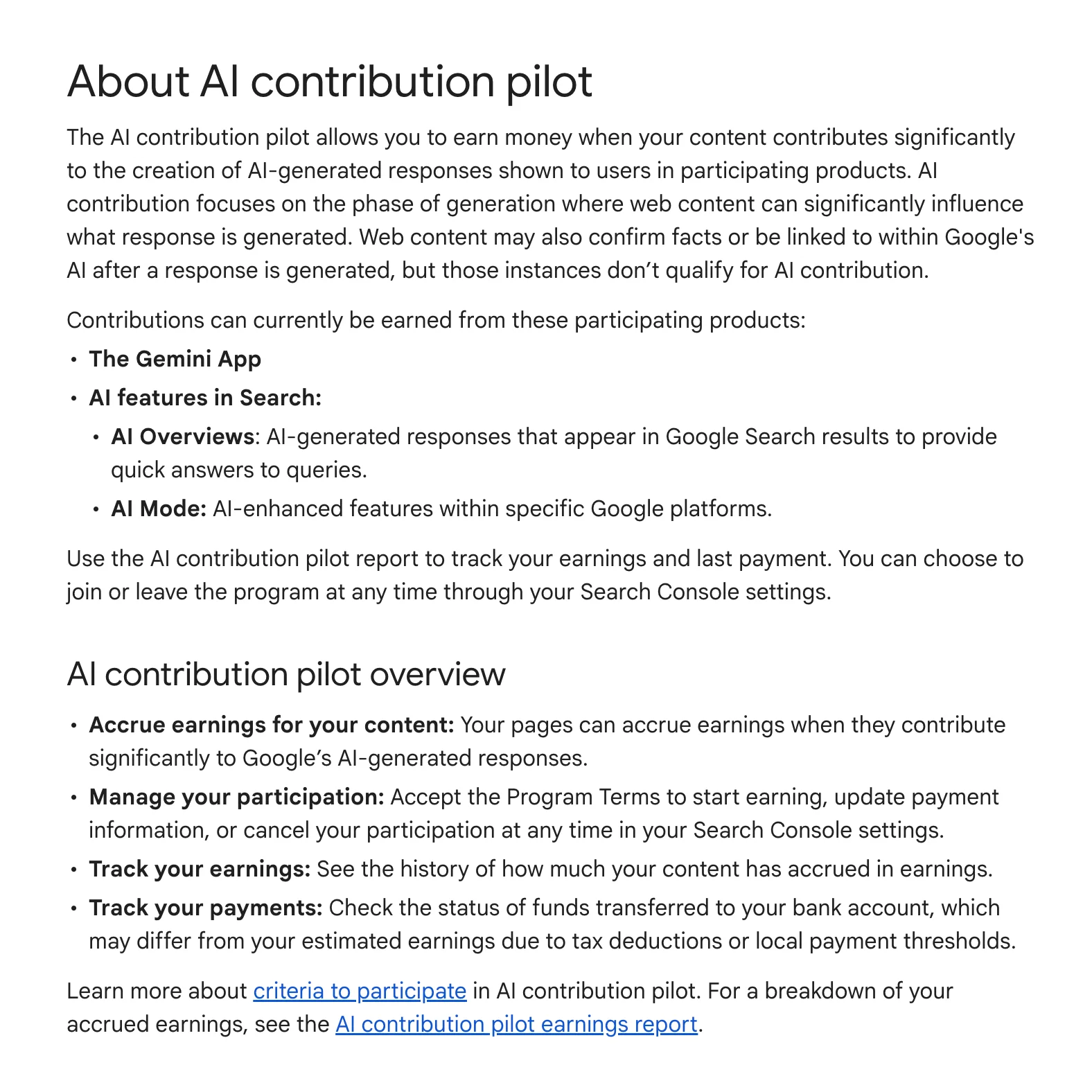
Digiday revealed the operational details on September 14, 2026 after speaking with multiple industry sources and viewing screenshots from participating Search Console accounts. Google confirmed to Digiday that the scheme was an early learning pilot designed to test methods for rewarding high-quality content. Digiday
The evidence establishes 5 confirmed features:
Participation is limited and invitation-only.
The program extends beyond traditional news publishers.
Participating products include Gemini, AI Overviews, and AI Mode.
Earnings depend on a significant contribution rather than raw usage alone.
Participating publishers receive an AI earnings panel in Search Console.
The pilot is not a public advertising product, affiliate scheme, or standard Search Console feature. Most website owners cannot enrol at the time of writing.
How does the AI Contribution Pilot work?
The AI Contribution Pilot follows a 4-stage process based on the information currently available:
Google invites a publisher to participate.
The publisher accepts the commercial terms and opts into the pilot.
Google determines when eligible content significantly contributes to a response in a participating AI product.
Google adds the resulting monthly earnings to a private Search Console panel.
Google has not published the complete technical or financial process behind stages 3 and 4. That missing layer matters because a value-based system requires Google to judge both contribution and price.
For example, an original investigation that supplies the central fact in an AI answer could carry more value than a page used to confirm a date. That example illustrates the likely principle, not a disclosed Google rule. Google has not revealed the signals or weights used in its valuation.
What does “significant contribution” mean?
“Significant contribution” means Google judges that a publisher’s content materially improved an AI response, but Google has not published a measurable definition.
Digiday reports that payments reflect perceived value rather than the total number of times Google accesses or uses a page. A citation, impression, or retrieval event therefore does not automatically generate money.
The distinction creates 3 possible content roles:
Core evidence: The source supplies a central fact, finding, or update required to construct the answer.
Supporting evidence: The source verifies or expands a claim that other sources already establish.
Incidental retrieval: Google fetches or considers the page without relying on it materially in the final response.
Only Google knows how the pilot classifies those roles. Publishers currently lack page-level contribution records, answer-level usage logs, and a published valuation model. As a result, the phrase “significant contribution” remains a contractual threshold controlled by Google.
Which Google products are included?
The reported pilot includes 3 Google AI products:
AI Overviews, which generate summaries above or among standard Google Search results.
AI Mode, which provides longer conversational answers and follow-up interactions within Search.
Gemini, which provides answers through Google’s standalone AI assistant and related experiences.
Product inclusion does not mean every appearance in those products qualifies for payment. Google reportedly pays for contributions that cross its internal significance threshold.
The products matter because they cover two different discovery environments. AI Overviews and AI Mode sit inside Google Search, while Gemini functions as a broader assistant. A contribution model spanning both environments could become more consequential than a Search-only licensing arrangement.
Is the pilot the same as Google’s other publisher programs?
No. The AI Contribution Pilot differs from Google News Showcase, the News AI pilot, and European press-content agreements.
Google described 3 existing partnership categories in June 2026:
The News AI pilot pays for enhanced rights and specialised content delivery methods.
European Extended News Previews agreements pay eligible press publishers for displaying press content.
Google News Showcase pays participating news organisations to curate and display licensed panels.
Google reported more than 200 publications in its News AI pilot, more than 5,500 European publications in Extended News Previews, and more than 2,800 News Showcase partners across 33 countries. Google Public Policy
The AI Contribution Pilot uses a different reported logic. Payment depends on the value Google attributes to content used in an AI response, rather than a conventional licence with a fixed annual amount or payment for a defined display format.
That distinction could turn content licensing from a negotiated publisher deal into an automated marketplace. The pilot has not reached that scale yet.
Is Google paying for citations, content use, or model training?
Google is paying pilot participants for qualifying contributions to AI responses, not for every citation and not necessarily for model training.
Three activities need to remain separate:
| Activity | What happens | Does it automatically earn money? |
|---|---|---|
| Citation | Google links to a source in an AI answer | No public evidence says every citation earns money |
| Grounding | Google consults current source material to improve an answer | A qualifying contribution could earn money inside the pilot |
| Training | Google uses data to develop or improve future models | Controlled separately and not presented as the pilot’s payment trigger |
Google explains that its Search generative AI control affects whether a site can appear as a link or help ground responses in AI Overviews and AI Mode. Google separately states that the control does not govern AI training. Website owners use Google-Extended to limit training for future Gemini models and grounding in Gemini Apps or Vertex AI. Google Search Console Help
The practical conclusion is narrow. A citation can signal visibility, but the pilot does not establish a public pay-per-citation rate.
Who is eligible for the AI Contribution Pilot?
Google has not published formal eligibility requirements for the AI Contribution Pilot.
Digiday reports that Google approached at least dozens of publishers. The participating group extends beyond news, and the offer has reportedly attracted more interest from small and mid-sized publishers than from large media companies.
The available evidence supports 3 eligibility conclusions:
Google selects participants directly.
A standard Search Console account does not make a site eligible.
Content outside traditional journalism can qualify for consideration.
The invitation pattern suggests that Google is testing content categories and publisher sizes before defining a scalable program. That interpretation is an inference from the reported participant mix, not an announced selection policy.
Can any website apply?
No public application process exists as of September 15, 2026.
Website owners cannot activate the program by changing structured data, joining Google News, or enabling a Search Console setting. An AI Contribution panel should be treated as genuine only when it appears inside the verified Search Console property and includes terms supplied directly by Google.
Publishers should be cautious about third parties promising access. Google has not announced authorised agents, paid enrolment services, or an application fee.
How much does Google pay publishers?
Google has not disclosed a standard rate, minimum payout, revenue share, or price per contribution.
Publishers cited anonymously by Digiday gave mixed assessments. One source described early returns as negligible relative to advertising revenue.
(Mockup AI Gen image of Potential Dashboard of the AI Contributor Program)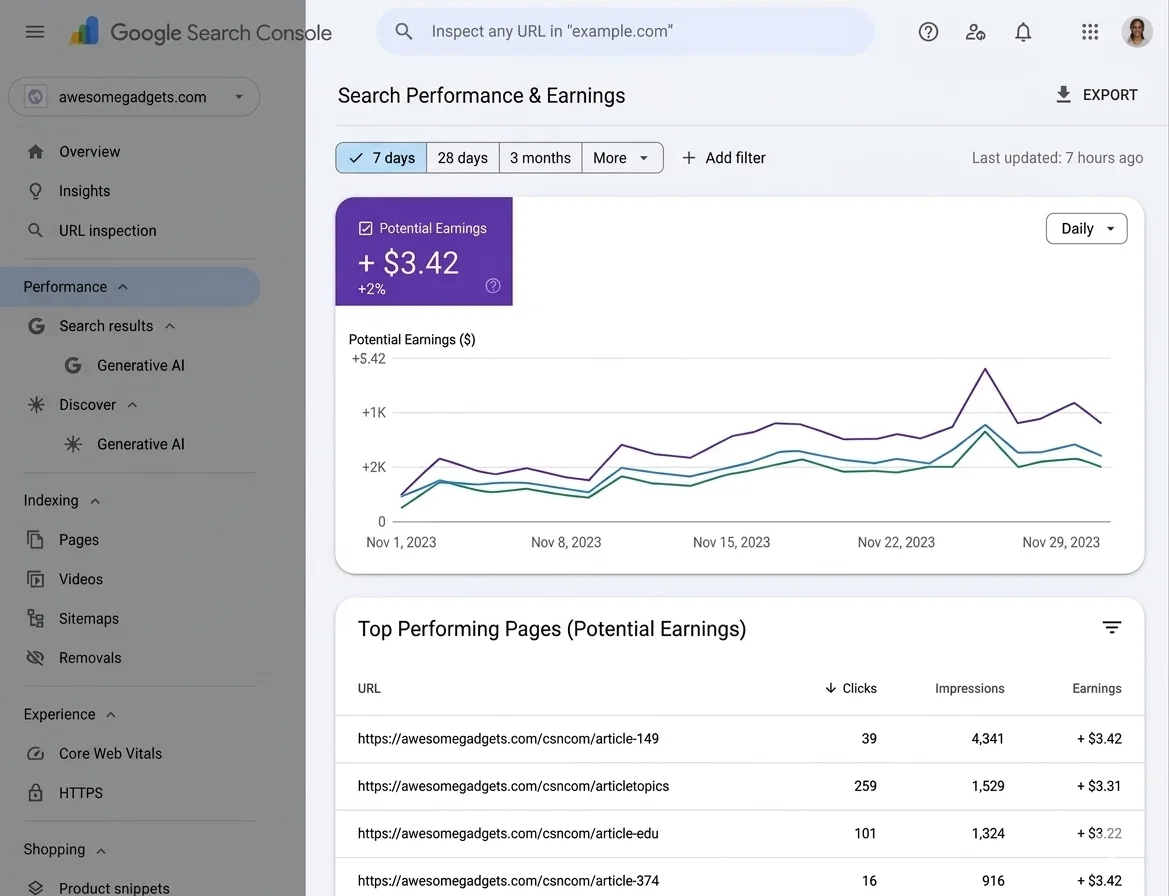
Another executive said the proposed amounts did not meet the publisher’s threshold for joining. Other participants considered the precedent and direct access to Google valuable despite wanting greater transparency.
Those accounts do not establish an average. No reliable public dataset currently shows:
Earnings per article
Earnings per AI answer
Earnings per 1,000 contributions
Earnings by topic or content format
Earnings by publisher size
Any article claiming a universal rate is estimating or inventing a figure unless Google publishes new data.
How are earnings shown in Google Search Console?
Participating publishers reportedly receive a dedicated AI Contribution panel that displays a monthly payout and limited historical earnings.
The panel does not appear to provide the diagnostic detail publishers would need to reproduce the calculation. According to Digiday, the interface currently lacks a clear explanation of how Google calculates each payment.
This creates a measurement gap between 2 Search Console experiences:
The generative AI performance report measures visibility, including impressions by page, country, date, and device.
The AI Contribution panel measures money, but reported screenshots do not expose the contribution-level formula.
Google’s public generative AI performance report includes AI Overviews and AI Mode. Google rolled the report out worldwide on August 31, 2026, although properties without sufficient impressions might not see data. Google Search Console Help
An impression is not an earning event. The performance report counts eligible link appearances, while the payment pilot applies an undisclosed value test.
Why is Google testing publisher payments now?
Google is testing publisher payments while AI answers weaken the traditional exchange of free crawling for referral traffic.
Pew Research Center analysed 68,879 Google searches linked to the browsing behaviour of 900 US adults in March 2025. Users clicked a traditional result during 8% of visits when an AI summary appeared, compared with 15% when no AI summary appeared. Links inside the AI summary received clicks during 1% of visits. Pew Research Center
Pew’s study does not prove that AI Overviews caused every publisher’s traffic loss. The analysis covers one US panel, one month of behaviour, and search results collected during a later period. However, the observed gap shows why publishers question whether referral traffic remains adequate compensation.
Regulatory pressure is creating a second incentive. The UK Competition and Markets Authority imposed a conduct requirement on Google in June 2026. The measure requires effective publisher controls, clear attribution in AI-generated search results, and the ability to prevent content from being used for fine-tuning. The CMA said those controls should strengthen publishers’ ability to negotiate content deals. UK Competition and Markets Authority
The pilot therefore addresses 3 connected risks for Google:
Publisher relationships weakened by declining search referrals
Regulatory demands for fair dealing and publisher control
Legal and reputational disputes about uncompensated content use
Google describes the program as an experiment in value exchange. Critics quoted by Digiday view the same program as a low-cost way to reduce those risks. Both explanations can be true at the same time.
Can publishers opt out after joining?
Yes, Publishers in the AI Contribution Pilot can reportedly opt out, according to Digiday.
Exiting the payment pilot is distinct from excluding a website from generative AI features. Google’s public Search Console control now lets a verified property choose whether its links and content can appear in or ground AI Overviews, AI Mode, and generative AI features in Discover.
Exclusion has 2 direct consequences:
The website’s content stops being eligible to ground covered Search AI responses.
The website loses impressions and referral opportunities from those covered AI experiences.
Google states that this choice is not used as a ranking signal for non-generative parts of Search. Google also says an exclusion generally propagates within 1 to 2 days after the control becomes active, although cached material can take longer. Google Search Console Help
Publishers invited to the payment pilot should review the private agreement before assuming that the public AI control defines every contractual consequence.
Does blocking Google-Extended remove a site from the pilot?
Google has not publicly explained how a Google-Extended restriction affects AI Contribution eligibility.
Google-Extended controls use for training future Gemini models and grounding in Gemini Apps or Vertex AI. The Search generative AI control governs AI Overviews, AI Mode, and generative AI features in Discover. Because the contribution pilot reportedly spans Search and Gemini, different content controls could affect different participating products.
Publishers should not treat Google-Extended, the Search AI control, robots.txt, and noindex as interchangeable. Each mechanism governs a different layer of crawling, indexing, display, grounding, or training.
Will optimising for AI citations increase publisher earnings?
No public evidence proves that higher AI citation volume increases AI Contribution earnings.
The reported payment model values significant contribution rather than raw exposure. A page could earn visibility without passing the payment threshold. A different page could contribute a unique fact that carries value even if the final answer presents the source less prominently.
Publishers can still improve their eligibility for retrieval by producing content with 5 qualities:
Original reporting or proprietary data
Clear factual claims tied to named sources
Current information with visible update dates
Specialist detail unavailable from interchangeable summaries
Accessible pages that Google can crawl and interpret
Those qualities improve information value, but Google has not certified them as payment factors. Publishers should optimise for audience usefulness and defensible originality rather than trying to reverse-engineer an unpublished earnings algorithm.
What should publishers do if Google invites them?
To evaluate an AI Contribution invitation, review 6 commercial questions before accepting:
Which rights does Google receive? Separate grounding, display, delivery, fine-tuning, and model training rights.
Which products are covered? Confirm whether the agreement includes AI Overviews, AI Mode, Gemini, Vertex AI, or future products.
How is value calculated? Request contribution definitions, reporting granularity, adjustment rules, and dispute procedures.
What revenue does participation replace? Compare proposed payments with advertising, subscriptions, leads, and licensing income exposed to traffic loss.
What happens after withdrawal? Confirm the removal timeline and treatment of previously supplied content.
Does participation limit future negotiations? Review exclusivity, confidentiality, precedent, and most-favoured terms with legal counsel.
The hardest calculation is not the payment shown in Search Console. It is the revenue that the publisher would have earned if the user had visited the original page.
What should SEOs and content teams do now?
SEOs should treat AI contribution as an emerging revenue signal, not a replacement for traffic, conversions, or brand demand.
An actionable 2026 measurement framework contains 4 layers:
Track generative AI impressions by page in Search Console.
Measure AI referral sessions and their conversion rate in analytics.
Monitor branded search demand after high-visibility AI appearances.
Record content production cost and direct commercial outcomes at URL level.
Invited publishers should add contribution earnings as a fifth layer. That structure makes it possible to compare direct payment with the wider value of being discovered, cited, visited, and remembered.
Content strategy should move toward information gain. First-hand tests, original datasets, expert interviews, local observations, and frequently updated reference pages give an AI system something distinct to retrieve. Rewriting facts already available across 100 pages creates little negotiating leverage.
Is the AI Contribution Pilot good for publishers?
The AI Contribution Pilot establishes a useful precedent, but the current black-box model does not prove that publishers receive fair value.
The case in favour rests on 3 benefits:
Google recognises that AI grounding events can create compensable value.
Smaller publishers gain a possible route into content licensing.
Search Console could develop into an AI usage and revenue feedback system.
The case against rests on 3 weaknesses:
Google defines significant contribution without a public audit method.
Early reported offers appear too low for certain publishers.
Participation could weaken collective pressure for more transparent licensing terms.
The decisive issue is transparency. A publisher cannot judge fairness from a monthly total alone. Fair evaluation requires the number of qualifying events, the pages involved, the products involved, and the valuation applied to each class of use.
Frequently asked questions
Is Google paying every website used in AI Overviews?
No. Google is paying a limited group of invited publishers inside an early-stage pilot. Normal inclusion or citation in AI Overviews does not create a known payment entitlement.
Is the AI Contribution Pilot available worldwide?
Google has not published the pilot’s geographic availability. The broader generative AI performance report and Search AI control rolled out worldwide, but that rollout does not make the payment pilot global or publicly accessible.
Does an AI Overview impression earn money?
No published evidence connects each impression to a payment. Search Console impressions measure link visibility. Pilot earnings reportedly require a significant contribution under Google’s internal assessment.
Are bloggers and independent websites eligible?
Potentially, but not through public self-enrolment. Digiday reports that the pilot extends beyond news publishers, which leaves room for specialist websites. Google has not released selection criteria.
Does schema markup qualify a website for payment?
No. Structured data can help Google interpret supported page attributes, but Google has not identified schema markup as an eligibility or payment factor.
Can a publisher see which article earned money?
The reporting described publicly is too limited to confirm reliable article-level attribution. Participating publishers reportedly see monthly earnings and some history, not a complete answer-by-answer ledger.
Does Google pay when Gemini cites a page?
Google pays pilot participants when content significantly contributes to a covered response. A Gemini citation alone is not a publicly confirmed payment event.
Is this payment for copyright licensing?
The pilot is described as a commercial value-exchange or licensing model. The exact rights depend on private agreements that Google has not published, so the legal scope cannot be generalised across participants.
When will Google open the program to everyone?
Google has not announced a public launch date. The company describes the program as an early experiment, and its future depends on what Google and participating publishers learn.
The bigger shift behind Google’s AI Contribution Pilot
Google’s AI Contribution Pilot matters because it assigns a visible monetary value to the act of grounding an answer. Search historically measured publisher value through rankings, impressions, and clicks. The pilot adds a fourth unit: contribution.
The first version remains incomplete. Google controls access, defines value, and reports limited payment detail. Publishers therefore have evidence that their content can earn money, but not enough information to decide whether the price is fair.
The next meaningful development will not be another earnings widget. It will be a transparent ledger that connects each qualifying use to a source, product, contribution class, and payment. Until that exists, the pilot is a precedent worth watching rather than a dependable new business model.