
The idea behind AI voice agents is pretty straightforward. Instead of hiring dozens of customer support representatives to answer repetitive calls, follow up with customers, handle bookings and call people back, why not let AI do it?
Some companies are even experimenting with AI cold calling. Even Jordan Belfort, the notorious salesman whose career inspired The Wolf of Wall Street, is promoting AI voice agent technology.

Apparently, we’ve reached the point where even the Wolf of Wall Street wants robots making the sales calls too.
Think large e-commerce businesses like Omaha Steaks, utilities, insurers and contact centres. Their biggest attraction may not be generating more revenue. It may be spending less on the hiring, training and staffing required to answer millions of repetitive calls.
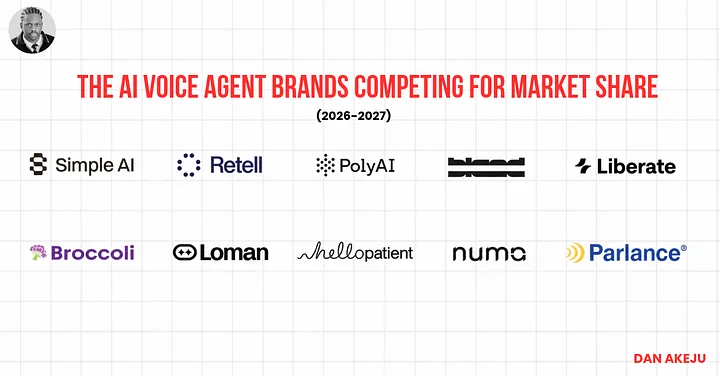
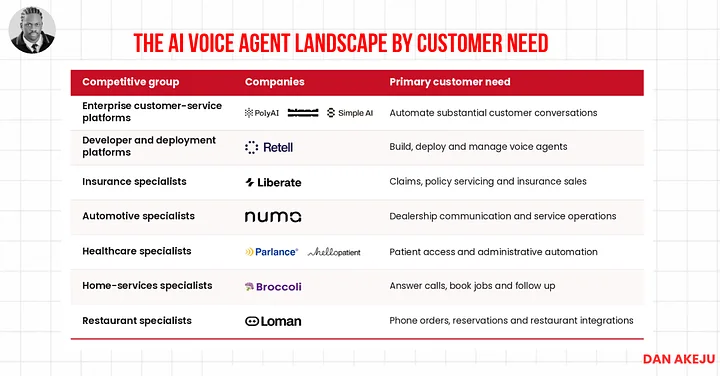
My research took me through ten providers: PolyAI, Bland, Retell AI, Simple AI, Liberate, Numa, Parlance, Broccoli, Loman AI and Hello Patient.
I investigated their marketing campaigns, pricing, founder interviews, hiring, customer case studies, conferences, partnerships, SEO and AI search visibility. I also looked at the people on the other end of these calls, because their opinions were rather less enthusiastic than the demos.
Along the way, I found Gordon Ramsay selling conversational AI, Soulja Boy in a giant telephone car, and employees dressing up as broccoli to sell software to contractors.
Apparently, enterprise software marketing has become its own reality television programme.
Underneath the costumes, though, is a much more interesting question: who is actually winning customers, how are they doing it, and where could their competitors take market share?
What I found across 10 AI voice agent companies
I went looking for how these companies win customers. Three patterns kept showing up.
- A trade show can keep working after everyone goes home. Simple AI turned its Omaha Steaks panel into a video and an article. A buyer who never attended the event could still hear how the agent performed on real sales calls.
- The job descriptions tell you what these companies want marketing to deliver. Bland wanted to track which campaigns generated pipeline. Numa wanted qualified inbound leads and meetings that actually happened. Anyone who’s stared at a calendar full of no-shows will appreciate that last distinction.
- An integration can be how a buyer finds you in the first place. Retell’s GoHighLevel workshop reaches developers trying to build a workflow. Loman’s Toast pages reach restaurant operators checking whether the agent will work with the system they already use.
Those are three ways a vendor can get in front of a buyer. But how many buyers are actually looking for voice AI? That’s where I started.
A multibillion-dollar market. But is anyone actually buying?
The industry pitch is almost suspiciously straightforward: businesses lose calls, customers wait, support teams cost money, and machines could handle part of the workload.
For a contact centre with ten million calls, that is a serious proposition. For a shop missing three enquiries a week, a clever voicemail system might do the job perfectly well.
I started with real deployments rather than the usual parade of market forecasts.
PolyAI’s PG&E case study describes a utility receiving roughly 16 million calls annually . PolyAI says its agent saved 35,000 labour hours , contained 67% of calls and raised satisfaction 22% .
I’d still want to know how containment was defined, whether customers’ problems were actually resolved, and what the fully loaded savings looked like.

When I lined up Google Trends with the May 2026 announcements, the rise in search interest coincided with two weeks of news that gave developers and business buyers different reasons to look up AI voice agents.
Twilio announced new infrastructure for connecting AI agents to phone calls on May 6, and OpenAI followed on May 7 with GPT-Realtime-2, a voice model that could handle interruptions and use tools during a live conversation.
On May 12, Ooma gave businesses a concrete example with its AI receptionist beta. Then Google I/O on May 19–20 put AI agents in front of a broader audience.
The timing suggests the announcements may have reinforced one another. Developers had new tools to build with, while business owners could see how the same technology might answer their phones.
But I’m not convinced that growing curiosity automatically means growing purchasing demand. That’s what I want to investigate next.
But Are Businesses Actually Searching for These Products?
I wanted to find out whether businesses were actively searching for AI voice agents or whether the industry was simply enjoying its latest round of AI hype.
So I went into Google Keyword Planner and Semrush to investigate.
The first thing I wanted to understand was whether buyers even knew these solutions existed. After all, the market only started gaining noticeable search traction around 2024–2025. Hardly what I’d call a mature industry.
Using data from Google Keyword Planner, I sampled 30 solution-aware phrases such as “AI receptionist” and 30 problem-focused phrases such as “call abandonment.”
Selected keyword group | Monthly searches | Share of selected sample |
|---|---|---|
Solution-aware | 204,700 | 98.96% |
Problem-focused | 2,150 | 1.04% |
 That gap might look unrealistic at first glance. Google Keyword Planner was the most reliable source I had for estimating search volume, but its figures are still estimates. Some of the problem-focused queries I chose showed no reported volume, so the actual gap could be smaller.
I chose the keywords myself, so the 99% figure describes the share of reported search volume in my sample.
Even after I removed the three largest solution keywords, solution-focused terms still accounted for roughly 96% of the remaining volume. The three biggest keywords made the gap wider, but the same pattern held without them.
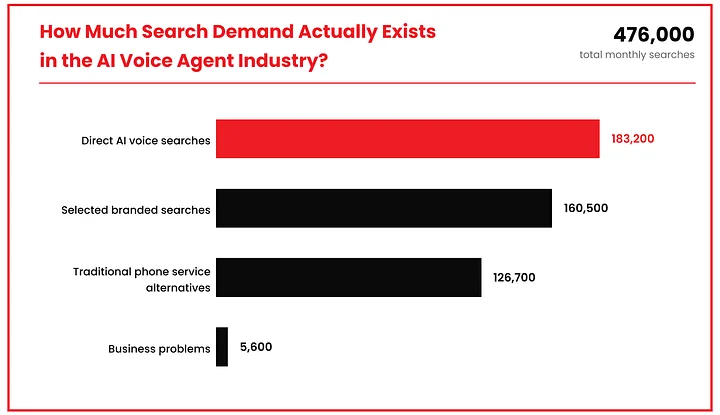
How Much Search Demand Actually Exists?
I expanded the research to include traditional answering services, virtual receptionists, business problems, and relevant branded searches.
After grouping similar keywords and removing obvious overlaps, I estimated 300,000–500,000 monthly searches worldwide.
Are Advertisers Willing to Pay for That Demand?
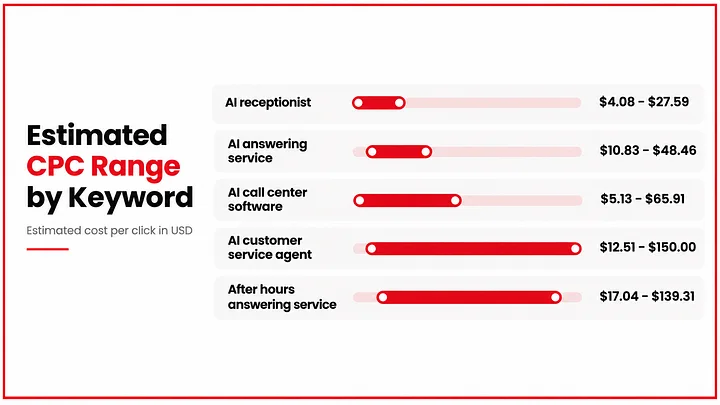 They’re estimates under the original keyword and account settings, not verified realised CPCs. Still, bidding in that range suggests at least some marketers believe customers can be worth a lot.
And some are. Telarus described a PolyAI sale to a business with about 160 locations , 200,000-plus annual calls and 20,000 missed calls . The eventual agreement was reportedly $135,000 annual recurring revenue , after around six months of sales. That’s a case study, not a normal contract size.
Usage-based providers can build serious revenue at smaller account sizes too. At an illustrative $0.11 per minute, 100,000 minutes per month generate $132,000 annual revenue, before discounts and delivery costs.
Retell has listed rates around $0.07–$0.31 per minute depending on configuration; Bland advertises $0.14 on Start and $0.12 on Build; Vapi’s $0.05 hosting fee leaves other model costs out. Comparing only the headline rates is how companies end up discovering the expensive part of “cheap” software after implementation.
So my verdict isn’t that the category is all hype, or that every voice startup has found a goldmine. Real companies are buying, commercial searches exist, and the unit economics can be substantial. The awkward question is whether these systems reliably solve problems once a customer answers the phone.
So, What Do People Actually Think About AI Voice Agents?
I spent over three hours collecting and reading 634 comments and 13 original posts across 13 Reddit discussions, from developers, business owners, call-centre workers and customers.
This was qualitative research, not a statistically representative survey, especially since some contributors were selling AI agents themselves. I wanted those unfiltered objections that tend to disappear somewhere between a founder’s LinkedIn announcement and the product demo.
Some developers described that demo-to-production gap as the central problem. Real customers interrupt, change subjects, have accents, ask difficult questions and expect the agent to remember what just happened.
One developer described some systems as “glorified decision trees with a neural TTS wrapper,” although they acknowledged useful applications in repetitive bookings and after-hours support.
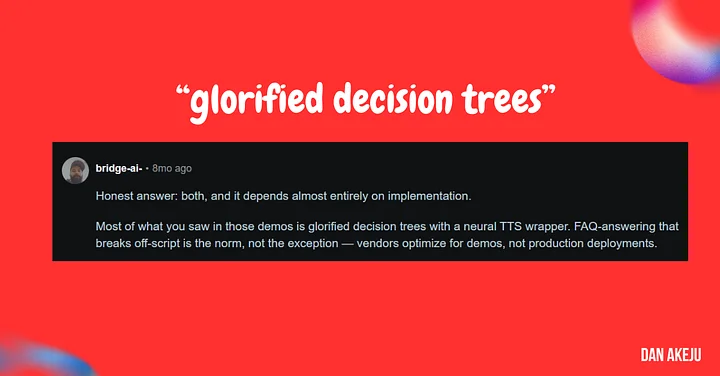
Not exactly the description you want to hear after spending six figures developing what your marketing team calls a revolutionary conversational AI platform.
One Reddit commenter thought bot fatigue made callers hang up. Another commenter argued that some people actually find machines simpler than dealing with humans. Which, considering some customer service experiences, isn't particularly difficult to believe.
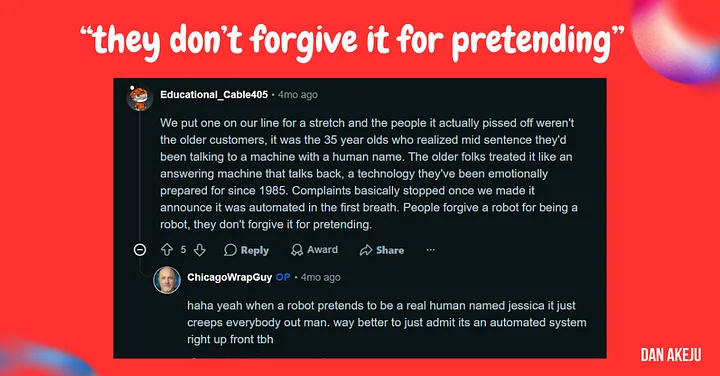
One business owner said , especially when it pretended to be a person. He mentioned complaints reportedly eased after the agent disclosed what it was.
The owner’s line was excellent: younger customers sometimes disliked the AI more than older customers “People forgive a robot for being a robot but they don’t forgive it for pretending.”
And then I found a criticism that may make every AI receptionist founder slightly uncomfortable.
A developer building automation systems for small businesses argued that the goal isn't answering the call; it's not losing the lead and sometimes an automatic missed-call text does enough.
Imagine spending six months building a sophisticated conversational receptionist, raising millions in venture capital, and hiring a team of engineers, only to discover that your biggest competitor might be an automated text message.
But, to be fair, a text message can’t qualify leads, handle complex conversations or complete bookings on its own. But for businesses primarily worried about missed calls, it’s an alternative worth comparing before signing an expensive contract.
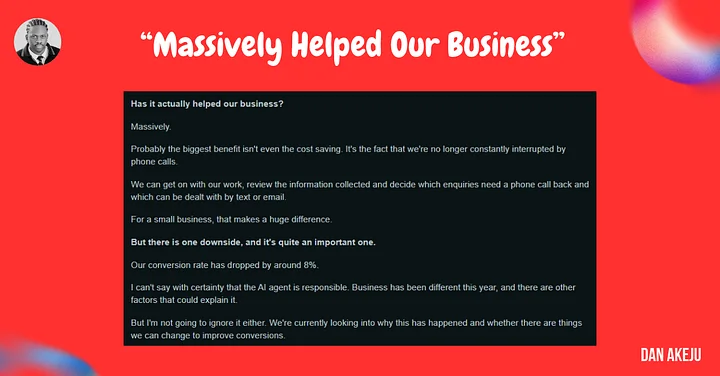
One small business owner said an AI voice agent helped their team work without constant phone interruptions and decide which enquiries needed a callback, a text, or an email. They also reported that their conversion rate dropped by around 8% and were still investigating whether the AI agent played a role.
Another contributor working with an AI phone-service provider recommended starting with after-hours and overflow, rather than replacing every incoming call.
I find that more plausible than announcing the end of human customer service before the agent can transfer someone without getting lost.
The pattern across complaints was consistent: latency, talking over callers, poor integrations, broken escalation and failed bookings.
The enthusiasm was consistent too: capturing missed leads, protecting staff time, handling repetitive questions and answering when humans aren’t available.
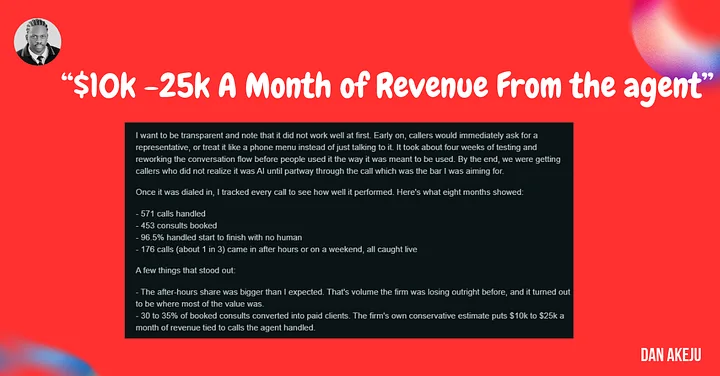
One AI voice agent builder said it took four weeks of testing and reworking the call flow before the agent worked as intended, then it booked 453 consultations over eight months. The firm estimated that calls handled by the agent were tied to $10,000 to $25,000 in monthly revenue.
What I took from the comments wasn’t “customers hate AI” or “customers love AI.”
It’s simpler: people hate wasted time and unreliable service, whether the person responsible collects a salary or runs on a server.
That distinction matters when the buyer is about to spend six figures putting the system in front of thousands of customers.
How Does an Enterprise Actually Buy an AI Voice Agent?
At first I tried to define the ideal customer by employee count but evidence pushed me toward a better variable: how many calls a business handles, how consequential those calls are, and how messy the existing systems are.
A 160-location business losing 20,000 calls has a much clearer problem than a larger company with a mostly self-service product.
I found two buyer groups pursuing similar technology for very different reasons.
Operations leaders want fewer missed calls, lower workload, better customer experience and completed transactions.
Technical buyers want API control, low latency, tests, integrations, logs and a platform they can actually deploy.
For a managed enterprise product, I would prioritise Heads of Customer Service, Contact Centre Directors and VPs of Customer Experience at call-heavy retailers, utilities, insurers, healthcare networks and hospitality groups.
Though, one enthusiastic operations director does not overrule a CISO. Enterprise software procurement remains committed to making sure everyone suffers equally.
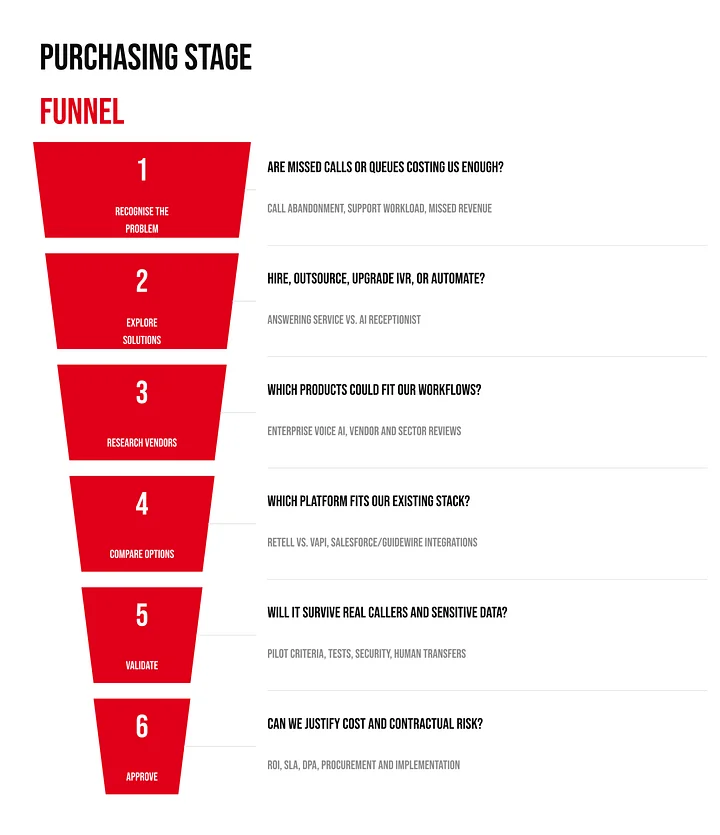
The Telarus-PolyAI case changed how I think about search’s role. A technology adviser introduced the vendor. Discovery expanded the requirements to chat; both sides agreed on proof-of-value measures using the customer’s own data; the reported $135,000 ARR deal followed about six months of work.
I’d argue it means search has more than one job. Sometimes it creates the first introduction. Sometimes it lets the buyer verify a recommendation, compare alternatives, understand integration risk or defend a decision internally.
You may never get clean last-click credit for that influence, which is inconvenient for anybody whose dashboard needs to explain the world in seven columns.
AI assistants complicate discovery further. I found two research reports that initially appeared to tell very different stories. G2’s 2026 buyer research said 82% of surveyed buyers had sourced recommendations from chatbots in the previous two years, with review sites ( 38% ) and AI chatbots ( 37% ) influencing shortlists.
The original report also cites 6sense finding 81% using LLMs, but only 17%–21% naming them influential in a decision. Those questions measure different things.
A buyer can ask ChatGPT for vendors and still trust a colleague, security review and live pilot far more than the chatbot’s final answer.
What I’d build is content for the whole buying committee: operations ROI, technical integration documentation, security information, implementation timelines, independent case evidence and finance-friendly cost models.
I lean toward search because those materials answer actual purchase questions at scale. But I wouldn’t pretend a brilliant integration page eliminates the need for a sales team, a partner network or a product that works.
The Buyer I’d Target First
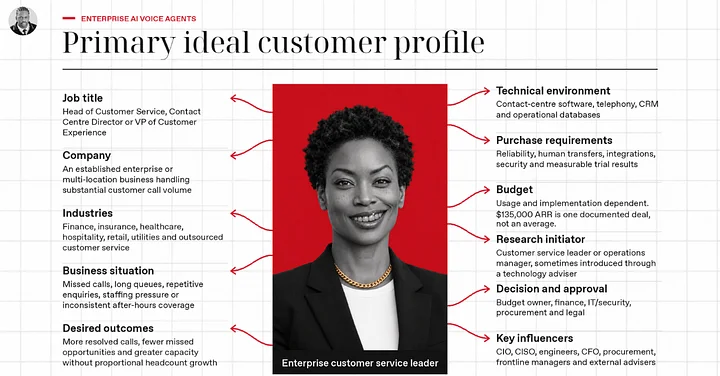
After examining the customer examples, buying requirements and reported deployments, I settled on a primary ideal customer profile.
A Head of Customer Service, Contact Centre Director or VP of Customer Experience at a call-heavy enterprise.
Not because every AI voice company should target this person, but because they have a clear operational problem and can potentially justify substantial spending when the solution works.
I found a useful example in PolyAI’s Atos customer story , which involved a Director of Customer Service and a Senior Operations Manager.
That reinforced my view that operational leaders can be central to adoption, while technical and commercial stakeholders determine whether the solution is acceptable.
What About Their Demographics and Online Behaviour?
I also looked at the demographic profile of contact-centre leadership. Australian census-based figures put the median age of contact-centre managers at approximately 42, with 57.2% aged 35–54.
I used that as a rough reference for a predominantly Millennial and Gen X leadership audience, not as a global demographic profile of enterprise AI buyers.
Then I checked Pew Research’s social media data to understand where comparable age groups spend time.
Facebook and YouTube generally had broader adoption than TikTok among comparable US age groups. LinkedIn remained professionally relevant, although its overall adoption was lower.
That doesn’t prove where enterprise software purchasing decisions happen. Someone watching YouTube every evening isn’t necessarily researching a six-figure contact-centre platform there.
But it does suggest that acquisition strategies shouldn’t assume every potential decision-maker lives on LinkedIn.
The Brands Competing for Market Share: Who They Are, How They Grow, and What Sets Them Apart
At this point I stopped treating “AI voice agents” as one market. A restaurant buying phone-order automation is not running the same procurement process as a bank choosing a customer-service platform. Nor is a developer evaluating Retell’s API necessarily competing with the operations team buying a managed PolyAI deployment. The technology overlaps; the customers, distribution and economics often don’t.
PolyAI: Gordon Ramsay sells the problem. The boring proof closes the contract.
I began with PolyAI, co-founded by Nikola Mrkšić, because it has the kind of enterprise references that make smaller competitors quietly update their pitch decks: Marriott, Caesars, PG&E and UniCredit.
Its positioning, “The Frontier of Agentic Dialog,” moves beyond answering calls toward managing customer conversations, bookings, payments, account questions and authentication. It also creates a messaging problem. “We answer the phone” takes three seconds to understand; “agentic dialog” sounds like a phrase that escaped from an investor presentation.
In February 2026 , PolyAI put Gordon Ramsay in a campaign about dreadful customer service. His restaurants reportedly use the product, which makes the endorsement more interesting than a celebrity reading whatever the agency handed them.

Agency Bou said the campaign generated 50-plus placements across digital, outdoor and US television. But I couldn’t find public evidence that those placements produced a specific number of paying enterprise customers.
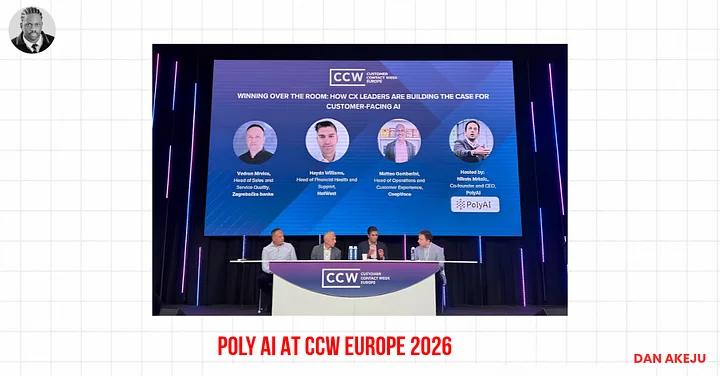
When I looked beyond the campaign, I found what might be PolyAI’s stronger acquisition machinery. At CCW Europe, October 5–7, 2026, Mrkšić moderated Winning Over the Room with leaders from NatWest and UniCredit.
At HumanX Amsterdam, September 22–24, the company joined discussions on voice agents and enterprise governance. A CCW Nashville gathering at Urban Cowboy Bar on October 8 collected prospect registrations.
PolyAI also has routes that don’t depend on a celebrity or a conference calendar: AWS Marketplace and advisers like Telarus , a $100 introductory API credit for builders, and its recognising executives from organisations including Visa, Barclays, Verizon and American Airlines.
Its Senior Marketing Manager, EMEA role explicitly covered pipeline, roadshows, executive dinners, developer workshops, hackathons and moving a platform business toward sales-led growth.
Managed enterprise pricing requires a sales call; model API access around $0.02 per connected minute plus tokens is not the cost of a full implementation.
The Telarus deal took roughly six months, and competitors are publishing PolyAI comparison content. If I were advising PolyAI, I wouldn’t try to out-Gordon-Ramsay Gordon Ramsay.
I’d build enterprise pricing explainers, implementation timelines, outsourced contact-centre comparisons, proof-of-value templates and industry-specific ROI pages to help qualified buyers arrive at sales with fewer objections. Search won’t replace the relationship. It can make the relationship easier to convert.
Poly AI SWOT Analysis in the Enterprise Voice Market
Strength: Where PolyAI Has an Edge
Weakness: Where PolyAI Falls Short
Now imagine arriving from one of those campaigns, only to discover that implementation scope, costs and proof-of-value criteria require several sales conversations. Custom pricing makes sense for complex deployments, but it also places expensive qualification work on the sales team. A six-month cycle is a long time for uncertainty to survive.
Opportunity: Where PolyAI Could Grow
Threat: What Could Cost PolyAI Deals
Bland AI: Enterprise Infrastructure With a Very Loud Marketing Department

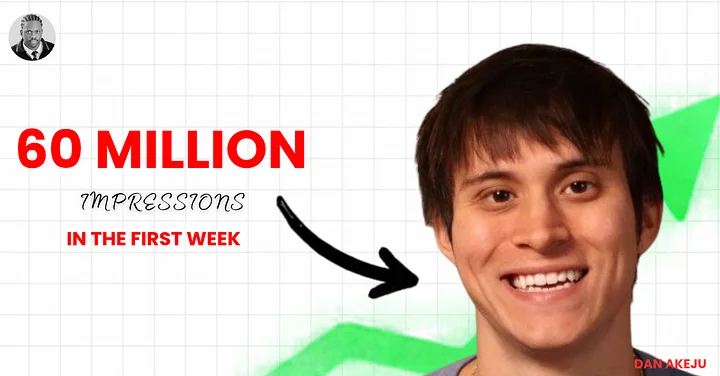
Then the car turned up at events and Soulja Boy joined a private wine tasting with customers and prospects.
It's “Still Hiring Humans?” billboard was arguably the stronger conversion idea. It had a number people could call to experience the agent themselves.
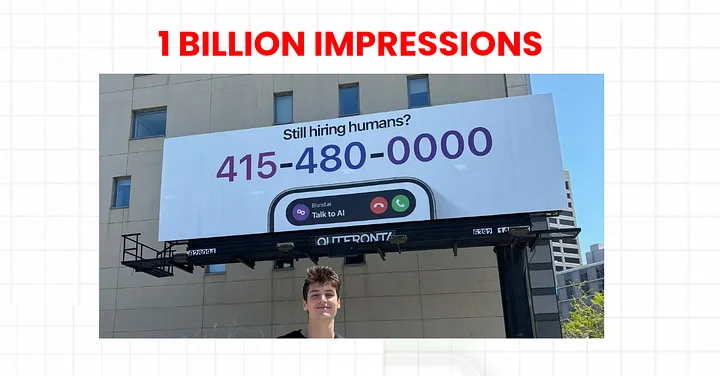
Bland reported over a billion impressions and booked sales calendars four months ahead. The clever part is that the ad doesn’t simply claim the product works; it makes the product the demonstration.

I also found much less flashy work underneath.Clouser discussed an handling architecture and landing pages , publication of roughly three articles a day , and a Reddit agency ; he reported around 20% month-on-month SEO growth and 50% growth in AI-search activity . The content covered proprietary voice models, enterprise security, vendor selection and ROI.
I noticed Bland’s Demand Gen Lead vacancy hinted at a bigger push to build enterprise pipeline. The role covered paid campaigns on Google, LinkedIn and Meta, alongside retargeting, outbound and account-based gifting. What stood out to me was the inclusion of HubSpot and attribution. Bland was hiring someone to run those campaigns and figure out which ones were actually turning into sales opportunities.
Pricing and Commercial Model
Bland’s published pricing includes:
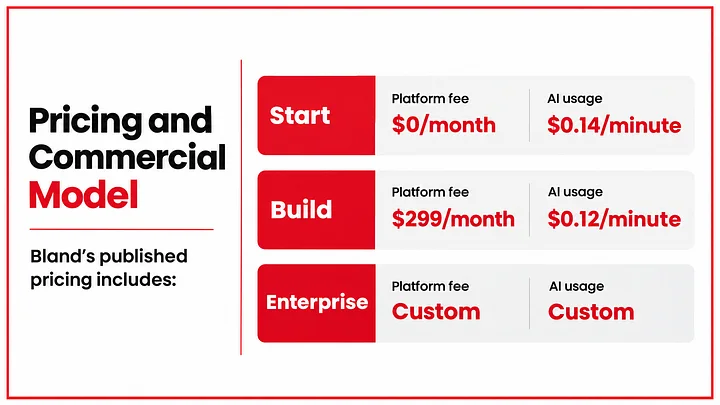
Telephony and applicable transfer charges are separate. At 5,000 AI minutes, Build costs approximately $899 monthly, excluding telephony and transfers.
Meanwhile, during my research I found 11 Bland reviews on G2 versus 2,638 for Retell. It does suggest Retell has far more third-party material for a buyer, Google or an AI assistant to consult.
My SEO priority for Bland would be transparent cost break-evens, production benchmarks, latency and concurrency evidence, and fair Retell comparisons. The giant phone gets attention. The evidence has to survive procurement.
Bland AI’s Competitive Edge and Blind Spots
Strength : Where Bland AI Has an Edge
I keep coming back to the billboard with a phone number. Bland didn’t merely claim its technology could hold a conversation; it let strangers call and test it. The Soulja Boy telephone car then became something the team could reuse at conferences and customer events. Attention became a demonstration, and a demonstration could become an opportunity. That’s considerably more useful than impressions alone.
Weakness : Where Bland AI Falls Short
The pricing creates a less amusing puzzle. At 5,000 minutes monthly, Start costs roughly $700, while Build is about $899 once its $299 platform fee is included, before extra charges.
I had to read the pricing table twice, because the plan with the cheaper minutes could leave you with the bigger bill.

Opportunity: Where Bland AI Could Grow
I’d publish a configurable cost calculator, Bland-versus-Retell comparisons, concurrency benchmarks and production tests for transfers and interruptions.
Those pages would attract buyers already evaluating vendors and can improve paid and outbound conversion as well. At five hypothetical Build customers spending $899 monthly, that’s roughly $53,940 annualised revenue, before usage changes.
Threat: What Could Cost Bland AI Deals
Retell’s developer community and a larger public review and discussion footprint can influence buying decisions before Bland enters the conversation. Bland knows how to win attention. The next competitive battle is whether its third-party evidence and commercial explanations are just as convincing.
Retell AI: Turning Developers Into a Customer Acquisition Channel
I found Retell, led by Bing Wu with co-founder/CMO Evie Wang, taking a different route. It sells voice-agent building and deployment infrastructure to developers, agencies and businesses. A developer who succeeds with Retell can deploy it across multiple clients.
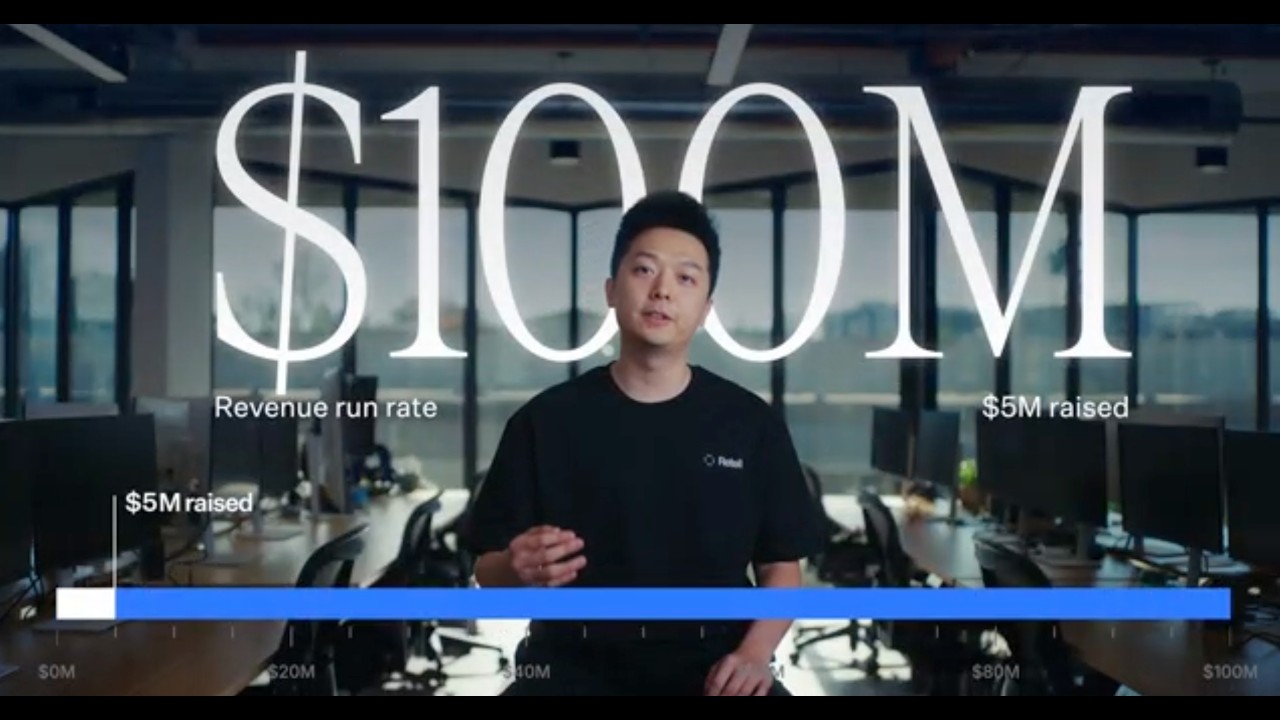
Wang discussed a Times Square billboard in February 2025 and reported about $4 million annualised revenue after nine months.

Retell didn’t stop at brand awareness. The Forge formalised paid creator promotion across YouTube, LinkedIn and Instagram, with briefs, bonuses and tiered benefits.
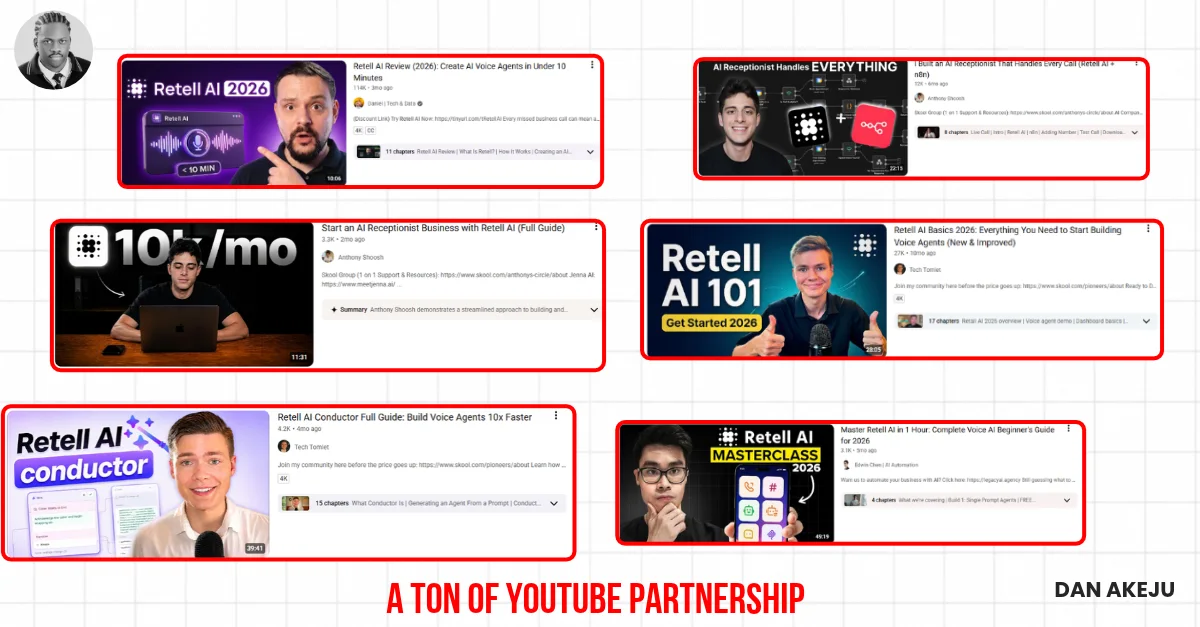
A July 14, 2026 advertising teardown observed 31 Google ads, 28 active then , about 138 LinkedIn library ads , and comparison messages like “Retell vs Vapi” and “Retell vs Air AI.” One campaign even offered AirPods for a demo .
The search and developer content is where I think the model becomes particularly interesting. Retell covers n8n, Make, Twilio, HubSpot and GoHighLevel , and a March 7, 2025 workshop walked through qualifying callers and booking meetings into a GoHighLevel calendar using n8n. Each tutorial can attract a searcher, teach deployment and create a potential long-term platform user.

A $170k - $230k SEO Role Targeting Google and ChatGPT
Retell’s official SEO Strategist/Growth SEO Lead vacancy lists $170,000 - $230,000 in compensation.
The responsibilities explicitly include:
- Google search and ChatGPT/Perplexity discovery.
- Programmatic and product-driven SEO.
- Consistency across documentation, blogs, landing pages and product.
- Technical SEO and AI-assisted content maintenance.
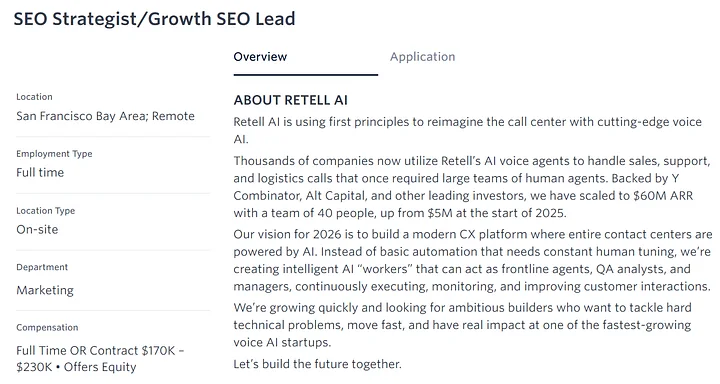
This is one of the clearest hiring signals of explicit investment intent in both traditional SEO and AI search.
And I know what you’re thinking: $170k -$230k a year, with equity? Where is the application link?

Trust me, I thought the same thing. I even applied. Got rejected.
So don’t bother. Apparently, Retell has standards, and I wasn’t part of the plan. (plus it’s onsite too, so not my Thang! )
It doesn’t prove the planned systems have already been implemented.But it tells us the company wants someone accountable for discovery across multiple surfaces.
Retell’s listed usage pricing spans roughly $0.07–$0.31/minute depending on configuration. It included 20 simultaneous calls without a platform subscription, compared with 10 on Bland Start, but total costs depend on voices and models; the original research estimated one ElevenLabs v3 setup could add about $4,250 a month at 50,000 minutes.
Reviewers also raised debugging, interruptions and agency reporting. I would try to connect comparison rankings, tutorials, creator referrals and integration docs to agents deployed, paid activation, production minutes and retained agency accounts. A thousand sign-ups that never leave the sandbox aren’t a developer ecosystem. They’re an enthusiastic mailing list.
Retell AI’s Strengths, Weaknesses, Opportunities, and Threats
Strength: Where Retell AI Has an Edge
A developer who builds one successful appointment-booking agent might deploy five more for clients. That’s the power behind Retell’s creator programme, workshops, integrations and developer content.
Its large G2 review footprint adds third-party material for buyers checking whether the product actually works. Every agency teaching a workflow can introduce Retell to another customer without Retell running the entire sales process.
Weakness: Where Retell AI Falls Short
Usage billing looks straightforward until models, voices, telephony and other components accumulate. A premium voice option in the source pricing could add approximately $4,250 per month at 50,000 minutes.
And when an agency manages dozens of clients, debugging and reporting are not minor inconveniences. They determine support costs and whether the agency renews.
Opportunity: Where Retell AI Could Grow
Retell’s SEO hiring brief explicitly names Google, ChatGPT and Perplexity. I’d use that mandate for more than top-of-funnel tutorials: integration troubleshooting, migration guides, alternative configurations, production testing and client-billing documentation.
The same content can acquire developers, speed activation and reduce churn when something breaks.
Threat: What Could Cost Retell AI Deals
Bland and managed providers can sell simplicity to a company that doesn’t want to maintain a voice stack. Retell’s best defence is making the builder successful enough that switching platforms feels like unnecessary work, not merely making the first API call easy.
Simple AI: Selling Revenue, Not Just Answered Calls
Catheryn Li and Zach Kamran positioned Simple AI around revenue-producing managed conversations rather than just call containment. The pitch is attractive to businesses that don’t want to hire engineers to maintain voice agents.

Simple takes on workflow design, integration, testing and upkeep, which can make the service easier to buy and harder to deliver profitably.
Then I discovered its origin story. According to Cath, an Omaha Steaks executive used an earlier Simple consumer calling app to prank-call another executive during a commute. That helped spark their relationship.

What interested me more was how Simple turned a customer into acquisition proof. At CCW Nashville in October 2026, Cath appeared alongside Rob Bradshaw of Omaha Steaks and Phil Engle of Renewal by Andersen, with Jordan Zivoder moderating.

Simple then turned the panel into a video and October 22 recap. It reported Omaha Steaks’ abandonment falling from 16% to 2%, 78% sales-call containment, and a separate 36% higher upsell rate than live agents.
But a named customer explaining real workflows is much more persuasive than a generic “AI increases productivity” post.
At Genesys Xperience, Simple also invested in booth, founder and integration conversations with contact-centre operators.
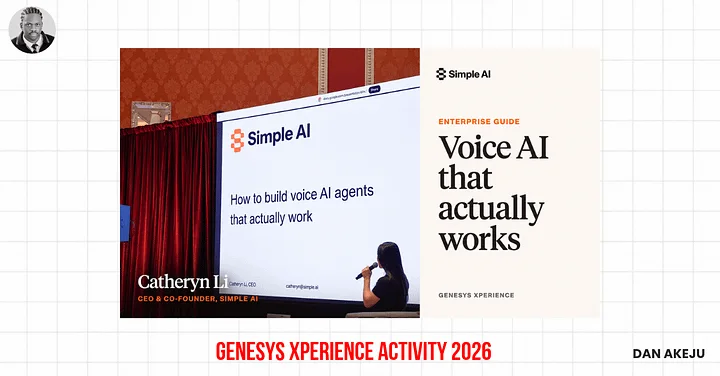
Its blog addressed revenue agents versus deflection, Genesys, build-versus-buy, abandonment and customer results.
When I checked as of November 8th, I counted five go-to-market roles within nine openings, including senior SDR, enterprise AE, founding growth marketer, sales engineer and head of sales. The growth vacancy mentioned paid search, retargeting, attribution and potentially billboards.
Simple’s managed pricing requires a sales conversation, while independent public reviews are less plentiful than for larger developer platforms.
I’d lean into managed-versus-build, implementation costs, Retell alternatives and call-revenue economics through search, then offer a real implementation assessment.
But, the counterargument is obvious: enterprise buyers may prefer introductions, demos and hands-on proof to articles. I’d use those articles to pre-qualify the right buyers and arm the sales team, rather than purely measuring the programme by traffic.
The success metric is incremental revenue after costs and failed calls, not how many calls the dashboard cheerfully declares “contained.”
Where Simple AI Wins and Where It’s Exposed
Strength : Where Simple AI Has an Edge
Simple AI’s strongest material isn’t the Omaha Steaks prank-call story but the commercial outcome behind it. The company’s CCW recap reports call abandonment falling from 16% to 2% and 78% sales-call containment. The figures are company-reported, but they speak directly to an executive who cares about lost orders, not how convincingly the agent says hello.
Weakness : Where Simple AI Falls Short
I’d still ask how much of that revenue was genuinely incremental. If some callers would have bought through another channel, a better abandonment rate doesn’t automatically mean the same increase in profit. Custom managed-service pricing also means the buyer needs the full cost of delivery and human fallback before judging payback.
Opportunity : Where Simple AI Could Grow
I’d create build-versus-buy comparisons, PolyAI alternatives, revenue-recovery calculators and implementation benchmarks. That lets Simple win buyers who have a budget but no interest in assembling an internal voice engineering team. Two hypothetical $2,000-per-month accounts would add $48,000 ARR; the larger win is proving that the agent produces incremental gross profit.
Threat : What Could Cost Simple AI Deals
Retell AI’s aggressive push into SEO and AI search is arguably one of Simple AI’s biggest competitive threats. Retell already has a substantial volume of customer reviews, giving it an advantage over almost every competitor on this list when buyers research vendors through Google, ChatGPT and other AI search platforms. And now it’s investing more heavily in making itself discoverable.
Simple AI needs to make deployment speed, revenue attribution and total cost of ownership compelling enough to compete with that visibility. Because a good prank might get you attention, but it won’t help much if Retell AI is the company buyers keep finding, comparing and getting recommended before Simple AI even enters the conversation.
Liberate: Teaching AI to Speak Insurance
Liberate , led by Amrish Singh with Ryan Eldridge and Jason St. Pierre , has made an intelligent decision: instead of telling every company on Earth that it can answer phones, it concentrates on insurance.
Sales, servicing, claims and integrations with Guidewire, Duck Creek, Applied and Vertafore are its territory. An AI that sounds reassuring while taking an accident report is not very useful if the insurer never gets a correctly created claim.
One of the stranger announcements in my research came in September 2026 . Liberate unveiled , proposing to detect when consumer AI assistants AI Intercept call insurance companies and route them to insurer AI agents.
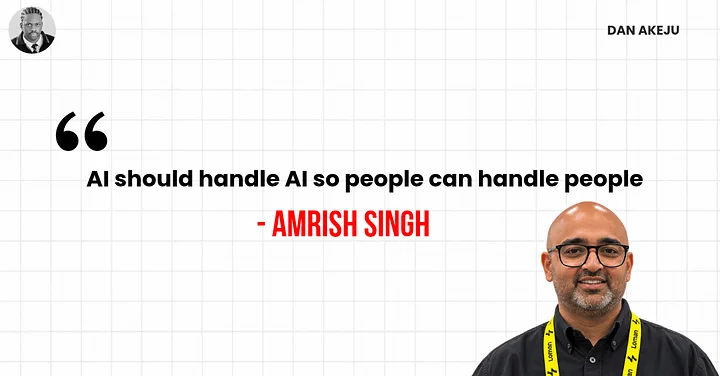
Singh described the idea as “AI should handle AI so people can handle people.” We have officially invented receptionists for robots. But beneath the comedy is a plausible bet on future agent-to-agent workflows.
I found a more grounded distribution too. Liberate exhibited at ITC Vegas 2026, booth 1613. In October 2025, it partnered with Covenir to offer IntellAgent, combining conversational AI and an onshore call-centre operation for first notice of loss and claims intake.

The company’s articles, including Your SOP Is Not the Spec, Detecting Hallucinations Is Already Too Late and Introducing Insights: Finding What Spot Checks Miss, speak to governance and implementation rather than just the novelty of a realistic voice.
Liberate’s careers page hinted at where it wanted to grow next. Of the 15 openings I counted, seven were in engineering, three in deployment or product, and five in sales or revenue, including RevOps and solutions engineering. I didn’t see a dedicated marketing opening in that snapshot. The mix suggested Liberate was gearing up to win more insurance customers and get them live once they signed.
Its Xodus case study reported 90% resolution of targeted calls without escalation and 37.5% lower abandonment.
My search opportunity is specific: Guidewire and Duck Creek deployment pages, FNOL examples, claims-status workflows, security answers, implementation-risk guides and comparison content for Sonant or native insurance-platform AI.
Those pages can reach buyers already asking expensive, specific questions. Could a trusted insurance partner generate better deals than organic search? Absolutely. But that same partner’s referred buyer will still need to investigate Liberate. I’d rather have the answers published than let a competitor write them first.
Liberate AI SWOT Analysis in the Enterprise Voice Market
Strength : Where Liberate AI Has an Edge
Weakness : Where Liberate AI Falls Short
Those same integrations create deployment work. Legacy systems, customer data access, security reviews and legal approval can stretch implementation.
Opportunity : Where Liberate AI Could Grow
I’d build Guidewire-specific use cases, claims automation comparisons, carrier-versus-agency paths and implementation timelines supported by named customers. Search could attract operations teams already investigating a particular bottleneck, while the proof reduces time spent qualifying unsuitable pilots. At three assumed $120,000-ACV customers, the potential is $360,000 ARR, not a prediction.
Threat: What Could Cost Liberate AI Deals
Insurance incumbents and software platforms already have trusted relationships and distribution. Liberate must show that its specialised outcomes justify another implementation. The more clearly it explains that trade-off in search, the fewer buyers it loses to whichever vendor is easiest to understand.
Numa: Turning Dealership Conversations Into Completed Appointment
Tasso Roumeliotis isn’t really selling the thrill of an artificial voice. He’s selling an automotive operating workflow: customer communications, voice, call intelligence, service scheduling and repair-order information. Answering “Is my car ready?” is one thing. Retrieving the correct repair status and triggering the right next step is where the value starts.
The best acquisition example I found had nothing to do with a viral campaign. During the June 2024 CDK outage , which disrupted dealership operations, Numa offered Numa Lite free to collect missed-call information without a DMS connection.
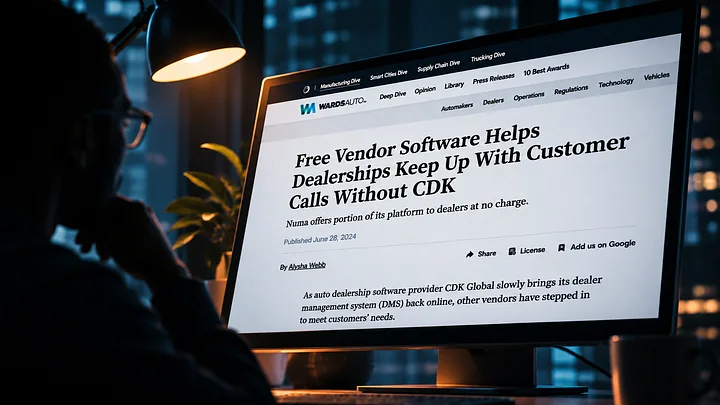
I think this is underrated marketing: show up when your exact buyer has an immediate problem, remove the usual integration hurdle and demonstrate a useful outcome. It doesn’t generate the same photographs as a telephone car.
At NADA Show, February 3–6, 2026 , Numa published a seven-vendor exhibitor guide interestingly awarded itself first place and directed readers toward booth 3401W .
Naturally, I was curious who’d won first place in the guide Numa published.
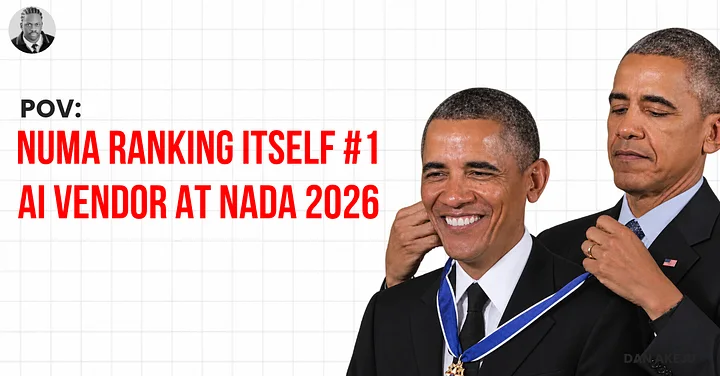
Jokes aside, it is also a sensible way to capture event-related searches before visitors arrive.
Numa’s GM iMR approved-vendor connection, FordDirect presence and other GM, Ford, Stellantis and BMW routes put it close to the ecosystems dealerships already trust.
I counted 12 dealership-focused articles from October 19 to November 9. They covered the calls dealerships actually get, from trade-in inquiries and cars that are already sold to phone trees, transfers and figuring out who’s ready to buy.
The $120,000 - $150,000 Growth Marketing Manager vacancy hinted at how the company wanted to turn that attention into pipeline. The role covered paid search, social, AI discovery, partnerships, lifecycle marketing and event follow-up. But the two metrics that caught my eye were qualified inbound leads and held meetings.
But the actual economics still depend on attendance, staff execution and service revenue. Impel’s Xtime integration and competitors such as HiBell create competing discovery routes.
I’d build OEM-specific searches, appointment-completion proof, Xtime integration pages and honest comparisons, then tie the analytics to repair orders, not vanity appointment counts.
OEM partnerships may outperform SEO as an initial acquisition channel. Search can capture and validate demand within the dealership before the vendor ever gets a meeting.
Numa SWOT Analysis in the Enterprise Voice Market
Strength: Where Numa Has an Edge
I liked Numa’s response to the CDK outage because it demonstrated awareness of how dealerships actually operate. Its OEM relationships, service workflows and dealership-specific content give it a narrower, more useful proposition than “AI for everyone.” A service manager can evaluate booked appointments and recovered revenue instead of judging a futuristic voice demo.
Weakness: Where Numa Falls Short
A published NADA guide ranking Numa first is useful marketing, but buyers also want independent proof. And a dealership has to connect calls to scheduling, staff capacity and completed repair orders. If the system books an appointment the service department can’t fulfil, the conversion metric becomes a customer-service problem.
Opportunity: Where Numa Could Grow
I’d target dealership call recovery, CDK integration questions, appointment-show rates, OEM-specific comparisons and abandoned service enquiries. The SEO asset I want is a calculator that continues from answered call to completed repair order and gross profit. Better pre-qualification can reduce CPL wasted on low-volume stores and improve ACV by attracting multi-rooftop groups.
Threat: What Could Cost Numa Deal
OEM platforms and dealership software vendors can market AI to customers they already serve. Numa has to document where its workflow outperforms built-in tools. The search result gets Numa into the comparison; retained service revenue wins the renewal.
Parlance: Three Decades of Experience in a Market Obsessed With New Startups
When I got to Parlance, I found a useful counterweight to the startup hype. This is a business with 30-plus years in voice automation, hospital routing and patient access, now using language like “AI Agents That Answer Every Call.” That history matters. Healthcare calls can involve unfamiliar clinician names, urgent transfers and complicated routing. A confident wrong answer can be much worse than an awkward silence.
Its marketing isn’t primarily about celebrity recognition. Parlance places actual operators in front of peers. I found activity at athenaTHRIVE in Nashville, November 2–4, booth 115, CHIME Fall Forum in Denver, November 11–14, and Becker’s Health IT Conference, September 14–16, booth 5106.
At HCCT 2026, Valerie Daugherty of Collaborative Health Partners presented with Parlance’s Katie Cardarelli, with material on bringing hold times to zero across 15 locations.
The research also identified Malik Bahar of Virtua Health at HCCT 2025, a Keck Medicine of USC webinar and This Week Health interviews.
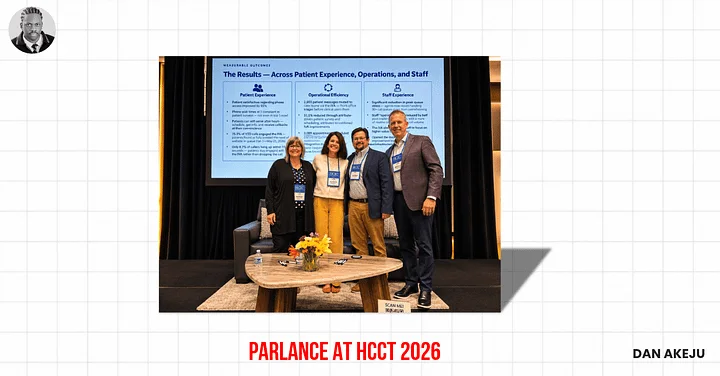
If I’m a hospital executive, hearing another hospital explain the problem is likely more reassuring than hearing a startup claim that its voice sounds 12% more human.
Parlance’s publication library covers HL7, ServiceNow, switchboards, patient access and ROI .
Marketing Hiring and Strategic Investment
Parlance may be gearing up to take its marketing efforts more seriously.
The company confirmed that Julia Chase joined in 2026 as Marketing Specialist, with responsibilities spanning LinkedIn, blog publishing, website content and industry events.
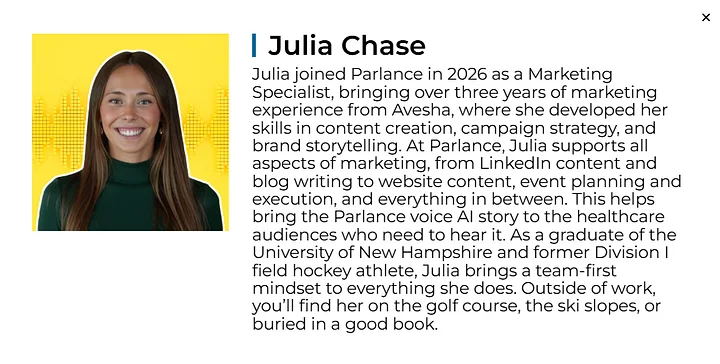 While her exact joining date isn’t disclosed, the hire suggests Parlance may be looking to strengthen its digital presence, increase content production and become more visible to potential buyers.
For a company with over 30 years of industry experience, this could signal a push to turn its established credibility into a stronger customer acquisition engine.
Here is the missed opportunity I see.
Parlance has evidence a newcomer would need years to accumulate, but a buyer searching “AI hospital switchboard” may never use the company’s older “speech attendant” or IVR vocabulary.
I would turn its practitioner presentations into current-term search pages, supported by security, deployment, ServiceNow/HL7, alternative-vendor and hospital ROI evidence. Sometimes better SEO is simply making genuine expertise visible in the language customers now use.
Parlance’s Competitive SWOT Analysis
Strength: Where Parlance Has an Edge
Weakness: Where Parlance Falls Short
Parlance can have the expertise buyers need and still lose the first search because the market has renamed the category.
Opportunity: Where Parlance Could Grow
Threat : What Could Cost Parlance Deals
Retell, in particular, already has a substantial volume of customer reviews, giving it an advantage over most competitors when buyers research vendors through Google, ChatGPT and other AI search platforms.
Perhaps Parlance is already feeling the pressure. The company hired a Marketing Specialist in 2026, which could signal a growing recognition that having an established product isn’t enough if newer competitors are capturing buyers before Parlance even enters the conversation.
Of course, we can’t say competitive pressure caused the hire. But the timing is interesting. Parlance has years of experience in enterprise voice automation, yet that history won’t necessarily translate into visibility when buyers ask ChatGPT which AI voice agent they should choose. Being in the industry longer doesn’t automatically mean being on the shortlist.
Hello Patient has more visible modern branding, while developer platforms let hospitals attempt their own builds. Parlance should turn its operational experience into the strongest searchable evidence in the category. Thirty years of credibility are worth much more when the next buyer can actually discover them.
Broccoli: Apparently, Dressing Like a Vegetable Is a Marketing Strategy
Broccoli , founded by AJ Jain and Adi Ketkar, sells to plumbing, HVAC and electrical businesses. The founders said they visited about 140 businesses and worked inside Armstrong Plumbing to understand dispatch fees, missed calls, Spanish-language calls and field-service follow-up. Integrations include ServiceTitan, Housecall Pro, Salesforce and AccuLynx .

And then there are the costumes. Employees dressed as giant broccoli show up in customer visits, street interviews, ride-alongs and videos.

At Pantheon 2026 at Orlando’s Swan and Dolphin, Broccoli promoted booths 242 and 116, merchandise, an ice cream truck, live demonstrations and a “Cash or Crash” game offering a chance at a 2026 Chevy Colorado. Jain said 35 employees attended with two launches.
Most SaaS founders have to fight for attention; Broccoli appears willing to become a literal vegetable to get it.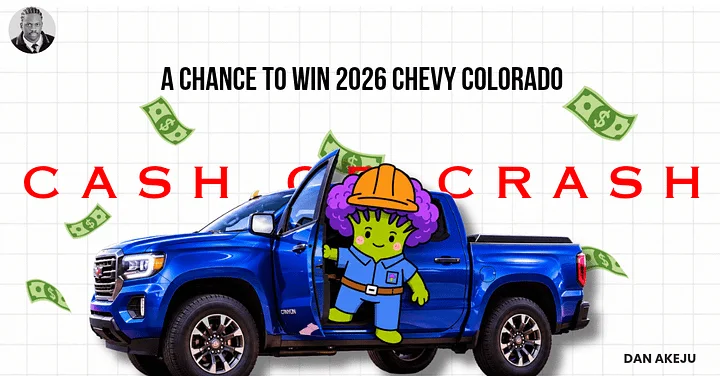
The product promises booked jobs and recovered leads for an audience where a missed call could mean real lost revenue. In the sampled period, I found only six blog posts between September 18 and November 6, mostly product, customer and company updates.
I counted 28 openings on Broccoli’s careers page. Three stood out for their advertised salary ceilings: $230,000 for Head of Growth, $350,000 for Head of Marketing and $190,000 for Product Marketing Lead.

The RevOps, sales and private-equity business development roles told me more about where Broccoli might be headed. The mix hinted at a plan to turn the attention it gets at trade shows into a steadier flow of deals, with private-equity relationships as a potential route into multiple contractor businesses.
The broccoli suit can win the first thirty seconds of attention. Search content and job-level evidence can help win the actual purchase.
The competitive risk is that ServiceTitan already has a place in those contractors’ day-to-day work. If its own AI can handle enough of the same calls, Broccoli has to give contractors a reason to buy a separate tool.
I would concentrate on ServiceTitan-versus-Broccoli, plumbing/HVAC answering-service comparisons, verified integrations and calculations based on completed jobs.
Ten missed calls a day, a hypothetical 30% booking propensity and $300 job value implies $900 daily gross potential; recover half over 30 days and that’s $13,500 monthly gross job value, not incremental profit.
The broccoli suit can win the first thirty seconds of attention. Search content and job-level evidence can help win the actual purchase.
Where Broccoli Wins and Where It’s Exposed
Strength: Where Broccoli Has an Edge
Weakness: Where Broccoli Falls Short
“Contractors” is a deceptively broad audience. A one-truck electrician and a ten-location HVAC group may both miss calls, but the budget, sales process and implementation needs are completely different. A generic landing page can produce enquiries while quietly increasing unqualified CPL and sales workload.
Opportunity: Where Broccoli Could Grow
I’d build trade-specific ROI pages, a detailed Broccoli-versus-ServiceTitan comparison and separate search journeys for small operators and multi-location groups.
A ten-location customer paying an illustrative $500 per location monthly represents $60,000 ARR, and one qualified group could be worth far more than dozens of small, low-fit enquiries. Measure recovered profitable jobs, not answered calls alone.
Threat: What Could Cost Broccoli Deals
ServiceTitan can promote native automation to users who already pay it. Broccoli has to demonstrate incremental value the incumbent doesn’t deliver. The broccoli suit makes a contractor remember the brand. A trustworthy comparison helps them choose it. Better job outcomes keep them paying.
Loman AI: Turning Restaurant Calls Into Completed Orders
A beautifully natural voice taking the wrong pizza order is not an improved customer experience. The restaurant might have preferred the original human error, at least for nostalgic reasons.
Loman leaned into memorable demonstrations. A New Jersey restaurant used an AI configured with a Tony Soprano-style persona, covered by Food On Demand in September 2025.

At Chicago’s National Restaurant Association Show, booth 8426, Loman brought a rotary telephone so restaurant operators could try an agent configured around their own menu. The buyer immediately discovers whether the thing understands an order, modifier, reservation or customer question.
In an August 2025 In the Pit interview , Wiens described shifting from cold email toward customer-filmed social advertisements inside restaurants . That is a meaningful channel decision: a real restaurant owner showing what happened can be more persuasive than another founder claiming every business needs AI.
Loman’s GTM Engineer vacancy, with $150,000 - $200,000 + in on-target earnings, listed Clay, Apollo, Instantly, HubSpot and workflows for personalising outreach. That gave me a clue about where Loman wanted to invest. It was hiring someone to automate the work of finding prospects, personalising messages and tracking outreach.
Then I checked the blog. Loman published 12 competitor comparisons in four days, August 18–21, covering companies including Slang, Kea, Hostie, Popmenu, PolyAI and ConverseNow. It followed with 14 integration posts from September 5 to October 17, covering tools like Toast, Square, Resy, OpenTable and SevenRooms.
The publishing sequence stood out because it answered two questions a restaurant operator might ask before booking a demo. How does Loman compare with the other options on my shortlist? And will it work with the systems my staff already uses? Loman was giving those buyers a reason to find its site while they were still deciding who to call.
The pricing page withholds exact Starter/Premium prices while claiming no per-minute fees, 99.6% order accuracy, 24–48-hour onboarding and training on 20 million-plus calls.
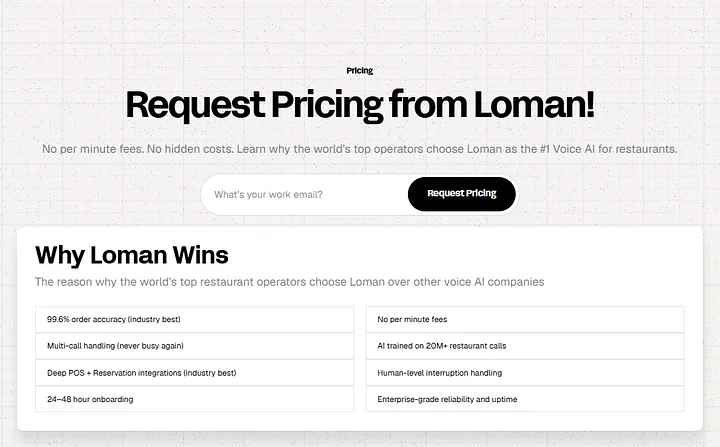
A few Loman users mentioned expense, add-ons and annual commitments, although Slang’s advertised $399 starting point offers a visible competing anchor.
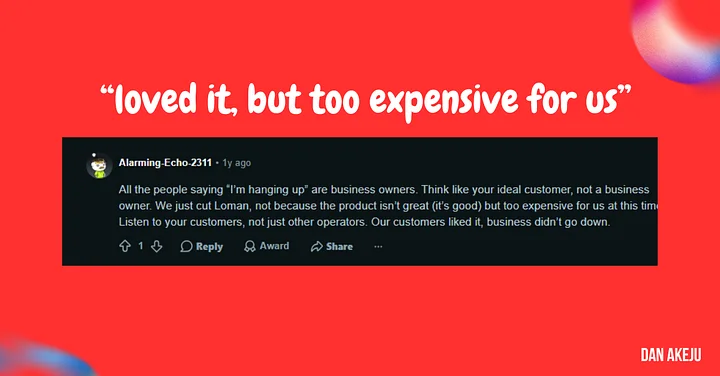
One Reddit operator reported cancelling Loman because it was too expensive, despite customers liking it.Another prospective buyer complained about add-ons and inflexible pricing.
This is the part of the renewal call where the owner opens the spreadsheet.
Loman Strengths, Risks, and Room to Grow
Strength: Where Loman Has an Edge
Loman’s rotary-phone demo and restaurant-filmed ads do something impressive: they let owners picture a real shift, not a laboratory conversation. The Toast, Square and reservation-platform content also answers compatibility questions close to purchase. It’s a more coherent buying journey than a generic AI receptionist pitch.
Weakness : Where Loman Falls Short
Restaurant operators care about contribution margin. In the Reddit material I reviewed, one operator described cancelling despite customers liking the product because of cost; another criticised add-ons. Neither establishes a churn rate. But together they illustrate the question every owner asks: did the recovered orders actually earn more gross profit than the subscription cost?
Opportunity : Where Loman Could Grow
Threat : What Could Cost Loman Deals
I finished the company research with Hello Patient, led by Alex Cohen and Nick DeRobertis. Its assistant, Mia, handles calls, texts, patient scheduling and approved administrative enquiries.
The promise, “Talk to every patient without hiring more staff” , is refreshingly plain English. In healthcare, though, the hard parts are EHR integrations, accurate workflows, sensitive information and escalation. Nobody wants a charismatic bot improvising medical advice.
I started with the founder rather than the product page, and I’m glad I did. In a Sourcery interview I opened for a quick fact-check, Cohen discussed being fired 11 times and extraordinary experiences involving Meta and Elon Musk.
Yep, I had to read that again too, Cohen was fired not once or twice, but eleven times. That might be a Guinness World Record at this point.

I intended to check one detail. I ended up watching the interview. Apparently, healthcare administration now comes with better founder lore than most Silicon Valley podcasts.
Then Hello Patient launched Nashville’s **”Talk Sh*t”** campaign: mobile billboards encouraging people to complain about doctors, plus a phone to record grievances.
Not the slogan I expected in patient-access software , but we’ll take it.

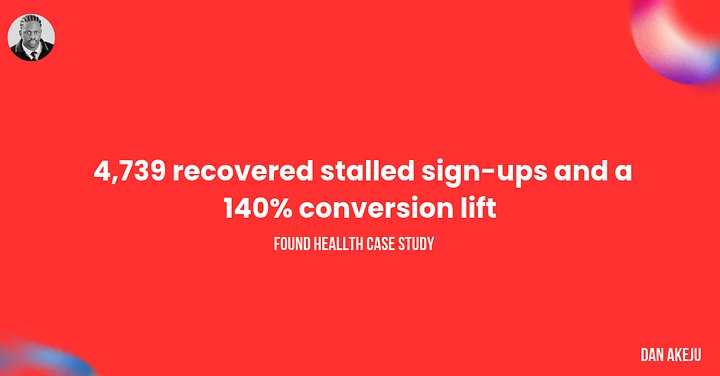
I’d want to inspect the baseline, attribution and patient-value assumptions, but that is the kind of result a healthcare buyer can discuss with finance.
My priority would be patient reactivation, abandoned booking recovery, EHR-specific integration pages and verified comparisons with human call handling.
I wouldn’t force SEO to replace conferences where clinical operators trust each other. I would make sure those operators can find the detailed proof online when they go back to their desks. The blue billboard makes someone curious; reliable patient outcomes determine whether anyone trusts the product with their practice.
How Hello Patient Stacks Up in Enterprise Voice
Strength: Where Hello Patient Has an Edge
Cohen’s audience can make an administrative product visible beyond its niche. But the commercial proof may be more valuable: the Found Health case study reports 4,739 stalled sign-ups recovered and a 140% lift over one-way SMS. Patient reactivation, scheduling and follow-up also provide several ways to expand an existing account, potentially improving ACV and retention.
Weakness: Where Hello Patient Falls Short
The FAQ’s six-to-eight-week implementation is a reminder that healthcare integrations aren’t magically solved by a good video. Different EHR systems, custom work and escalation requirements complicate onboarding. Without clear implementation pathways, awareness can turn into a growing queue of prospects who aren’t ready to deploy.
Opportunity: Where Hello Patient Could Grow
I’d build SEO around patient reactivation, abandoned intake, EHR-specific scheduling and specialty-specific call workflows, supported by the seven named customer stories.
Recovering 100 retained patients at an assumed $100 monthly provider revenue would equal $120,000 annual provider revenue, before costs or churn. That’s not Hello Patient’s ARR; it’s the kind of customer-side economics that can justify a purchase.
Threat: What Could Cost Hello Patient Deals
Parlance has established healthcare relationships, while Retell offers a route for technical teams to build internally. Hello Patient should make its implementation speed and verified outcomes easier to compare. The Nashville billboard earns the laugh and the case study and deployment plan earn the purchase.
Ten acquisition strategies, and why I couldn’t crown a winner
Once I laid the ten companies side by side, I understood why a simplistic “best voice AI marketing” ranking would be ridiculous.
PolyAI can enter through advisers and enterprise relationships. Retell can enter through a developer tutorial.
Bland might get a call because somebody saw a giant telephone. Parlance can get invited by a hospital operator who has used it for years. They aren’t even playing on the same field, never mind using the same scoreboard.
So, I built a matrix of activity I could document.
D means I found a public campaign, asset or activity. P means a job description or stated plan suggests an investment without proving execution.
A blank or “not established” isn’t an accusation that a company does nothing. Private pipelines are, inconveniently, private.
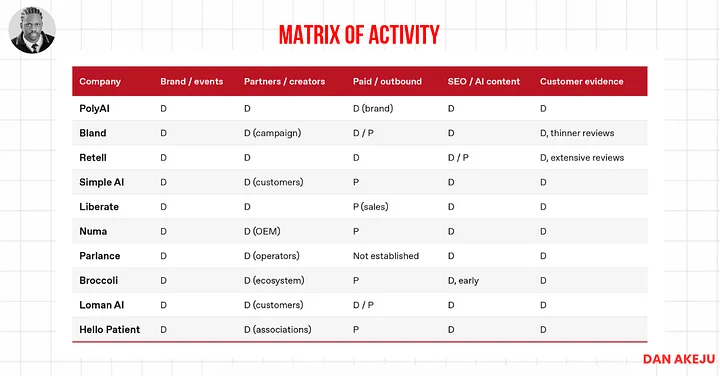
Three patterns changed my thinking.
First, the best events don’t end when the venue closes.
Simple AI turned its CCW panel into a video and article. Parlance publishes hospital practitioners’ experiences. Loman’s menu-specific rotary-phone demo can become social content or a sales follow-up. It’s a mistake to compare the ticket price with just badge scans when the resulting customer evidence can LITERALLY keep helping sales and search for months.
Second, companies are increasingly hiring for a measurable pipeline.
The briefs hint at where these companies plan to invest. They’re hiring people to answer two questions that matter once the demo is over. Where will the next customer find us, and how will we know what brought them in?
Third, integrations are often an acquisition channel disguised as product functionality.
Retell’s GoHighLevel workshop reaches builders in an existing ecosystem. Loman’s Toast pages meet restaurant operators checking compatibility. Numa’s OEM relationships and Liberate’s insurance-stack integration claims reduce the buyer’s perceived risk.
Search pages, partner listings and live workshops can reinforce each other. I’d take a well-supported integration page that generates three genuine sales opportunities over a generic article generating 3,000 visitors. Yes, I know that is an uncomfortable sentence for people who report marketing success exclusively in traffic graphs.
But there’s a catch to my search preference: sometimes a trusted introduction matters more than being ranked first. Telarus shows that. Hospital associations show it. OEM routes show it.
My argument isn’t that these companies should abandon outbound, events or partners to write blog posts.
It’s that every serious channel eventually creates questions that someone must answer. Detailed, findable, trustworthy content can do that work repeatedly, including for buyers who arrived through another channel.
I followed the money. The SEO opportunity is hard to ignore.
Once I compared the keyword costs, buying journeys and contract values, I became convinced of something: SEO is one of the strongest underused acquisition opportunities in this category.
Buyers are already searching for alternatives, integrations, security details, prices and implementation evidence. These aren’t vague “what is AI?” queries. They’re the questions people ask while deciding which vendor to pay.
The company that answers them well can influence a six-figure purchase, and the answer stays available long after a paid campaign ends. That doesn’t eliminate the need for sales, partners or a product that works. It makes each of them more effective.
Here’s how I’d separate the jobs.
Brand campaigns create attention and familiarity.
Outbound can reach accounts that weren’t searching.
Conferences and partners move through existing trust networks.
Paid search tests demand quickly, but charges for each click.
SEO can capture recurring high-intent questions and support evaluation without paying per visitor, but takes time and isn’t guaranteed.
AI search can help a company enter consideration before a website visit, although attribution is especially messy.
I tested the economics with a deliberately simple illustration from the source research.
Suppose paid search spends $20,000 on 100 leads, closes 2%, and wins two customers: $10,000 channel CAC.
Organic invests $10,000, generates 40 leads, closes 15% and wins six customers: about $1,667 CAC.
At $24,000 ACV, that’s $48,000 versus $144,000 new ARR.
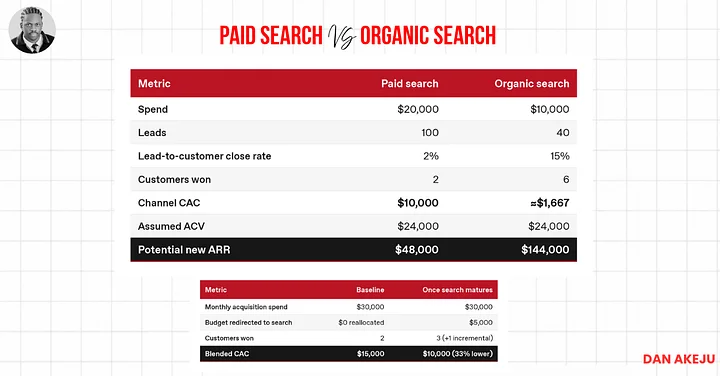
It looks like a spectacular organic advantage. It is also hypothetical. If the paid leads are better qualified, or the organic close rate isn’t real, the result changes dramatically.
The lesson isn’t “SEO always wins”; it’s that lead quality matters far more than lead counts.
Is search a better use of the budget you already have?
If I were running an AI voice company, I’d want to know what happens if I take $5,000 I’m already spending on customer acquisition and move it into search. Once search has had time to work, do I end up with more paying customers than I would have won with the original budget?
That’s where the numbers get interesting. One extra customer can cut acquisition costs by a third on the same budget. But the value of that win depends on what the customer pays, how much gross profit the account generates and how long they stick around. A six-figure enterprise account and a restaurant paying $500 a month give you very different amounts of room to spend.
So before I’d move more money into search, I’d want to follow the deals it brings in. Which ones are qualified, which ones actually sign, and how long does it take those customers to earn back what we spent to win them?
Let’s start with what one extra customer does to a $30,000 monthly budget.
A Typical Scenario: What $30,000 Can Do
If we redirect $5,000 of that budget into SEO and, once the programme matures, win a third customer we would otherwise have missed, we’re now spending the same $30,000 to win three customers . Our average CAC falls to $10,000 , a 33% reduction . If one of our original two customers simply comes through Google instead, we still end up with two customers at $15,000 each .
The same acquisition cost can make sense for one customer and be too high for another
Suppose that extra customer is a restaurant paying $500 a month for a voice agent. That’s $6,000 in first-year revenue. If it costs us $10,000 to win that account, a full year of subscription revenue still leaves us $4,000 short, even before the cost of serving the customer.
How long those customers stay changes what the campaign is worth
Now, if we start the year with 100 customers paying $2,000 a month. That gives us $2.4 million in starting ARR. If 15 customers cancel, we end the year at $2.04 million in ARR. If five cancel, we end at $2.28 million, with everything else held constant.
Those ten cancellations explain the $240,000 difference in year-end ARR. Now apply that to the customers we acquire through search. If we win those accounts more cheaply but they cancel sooner than similar customers from other channels, some of the savings on acquisition can disappear in the gross profit we lose. The timing matters most when customers leave before we’ve recovered the cost of winning them.
A $60,000 contract can take 16 months to earn back its acquisition cost
Suppose one of the customers we win signs a $60,000 annual contract. At a 75% gross margin, that account generates $3,750 in gross profit per month. Here’s how long it takes to recover the acquisition cost at that rate.
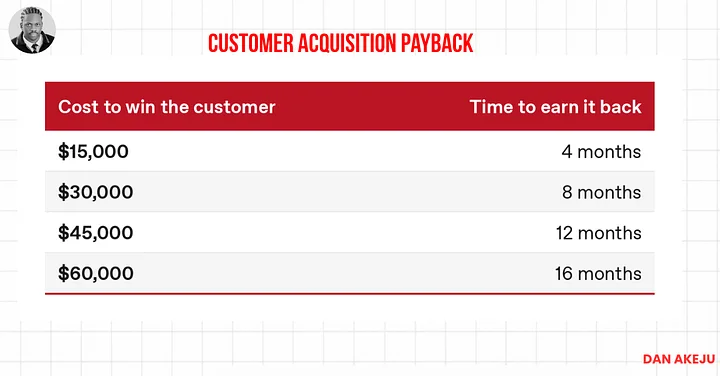
If we spent $60,000 to win the account and it leaves after year one, we’re still $15,000 short. If we spent $30,000, the same account would have paid back in eight months. That’s the financial upside of winning a comparable customer more cheaply through search.
We recover our acquisition spend sooner and have more time to earn gross profit before the account leaves.
The budget shift starts to show up in signed deals
Suppose this is what our qualified pipeline looks like after one quarter.
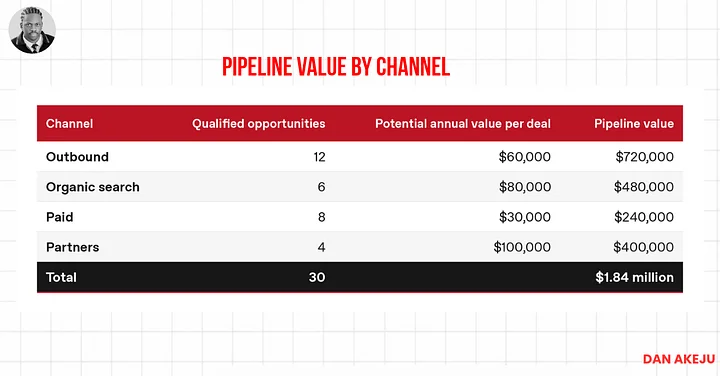
Organic search accounts for $480,000 in potential deals . If two of those deals sign at $80,000 each , that becomes $160,000 in new ARR . If those are customers we would have missed without search, the shift has added revenue without increasing the acquisition budget. How much it ultimately adds to the business depends on the gross profit those accounts generate over the time they stay.
That’s what makes the original $5,000 shift interesting to me. We could turn money we were already spending into two enterprise contracts we might never have seen, then trace what those contracts contribute after paying back the cost of winning them.
Where AI search makes the picture stranger
G2’s 2026 Answer Economy research reported that 51% of surveyed software buyers started with AI chatbots more often than Google, 80% still used Google somewhere in research, 69% said chatbot guidance had changed a vendor choice and 33% reported buying from a previously unknown provider surfaced by AI. Those are self-reported findings across software categories, not proof that a third of enterprise voice contracts originate in ChatGPT.
The AI Visibility Benchmark sample Daydream had PolyAI appearing in 76%, Retell in 53% and Bland in 42% of one mid-market recommendation set.
When I checked Daydream’s November AI Voice Agents leaderboard, Retell AI came first, recommended in 48% of the 510 answers sampled. PolyAI appeared in 28.4% and Bland AI in 26.1%. Of the ten companies I researched, those were the only three on the published leaderboard. I didn’t see Simple AI, Liberate, Broccoli, Loman, Hello Patient there.
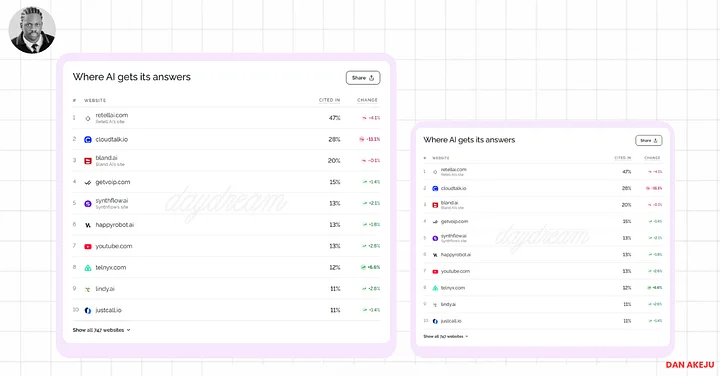
That lines up with what I found in my SEO research. Retell and Bland were two of the companies I saw putting visible effort into search, and their own websites were among Daydream’s three most-cited sources.
The ranking reflects the prompts Daydream tested, so I’d be careful about reading too much into who was missing. What stood out was that Retell and Bland were showing up both as recommendations and as sources the AI tools used to answer the question.
I see an opportunity and a measurement headache. AI might introduce a specialist like Liberate to an insurer who has never heard of it. It might just repeat whatever established reviews and documentation already say about famous vendors. A buyer could ask ChatGPT for a shortlist, verify an integration on Google, read G2, then book directly. So which channel deserves the revenue? Anyone insisting on a precise answer without buyer-level evidence is performing analytics theatre.
I’d measure non-branded high-intent rankings, qualified AI recommendation share, referred demos, source-of-awareness answers, SQLs, won customers, fully loaded CAC, payback and retention.
A $5,000 monthly search investment becomes $60,000 annually. At an assumed $36,000 ACV, one, three, five or ten incremental customers imply $36,000, $108,000, $180,000 or $360,000 potential new ARR. That still isn’t profit or a forecast. Sales expense, margin, churn, attribution and contract timing have to be included before anyone starts celebrating.
I’d invest confidently in SEO and AI discoverability , especially comparisons, integrations, pricing, deployment, case studies and ROI. These pages aren’t decorative marketing.
They capture active demand, qualify leads and support the entire buying committee. A conference can start a conversation. Strong search content keeps moving that conversation toward a contract.
What I’d actually report to a founder is a cohort: qualified organic leads → sales meetings → customers → first-year gross profit → retained revenue.
CPL tells me how expensive the initial lead was, CAC includes the cost of getting to a customer, ACV tells me the size of the prize, and churn tells me how much of that prize survives.
A $60,000-ACV win with poor retention is less impressive than a slightly smaller deal that renews.
SEO’s advantage is that a successful comparison, integration or implementation page can keep influencing those cohorts long after the original publishing cost.
Ten commercial opportunities with the assumptions exposed
After researching all ten companies, I couldn’t justify handing them one interchangeable “publish 20 blogs a month” proposal.
Their markets, budgets, integrations and sales cycles are too different. I built the following annual SEO/GEO opportunity model to test how much incremental business might make a focused programme worthwhile.
Treat every non-documented input as an assumption, not a forecast or a proposal to spend all this money tomorrow.
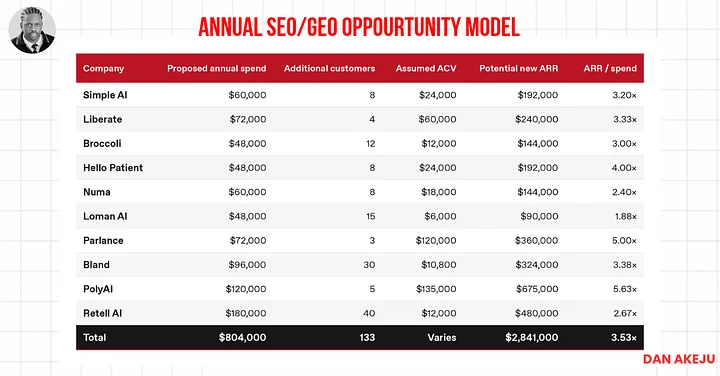
All new customers, annual programme budgets and most ACVs are assumptions. PolyAI’s $135,000 assumption is grounded in one Telarus-reported contract, not an average. ARR divided by programme spending is not net ROI, realised first-year revenue or cash payback; it excludes sales and delivery expenses, margins, churn and contract timing.
Simple AI
I would capture the managed-versus-build decision. I’d use implementation-cost pages, Retell alternatives and PolyAI comparisons to lead buyers toward an assessment, then substantiate the pitch with the Omaha Steaks results.
The model needs 40 qualified opportunities closing at 20% to win eight accounts at $24,000 ACV, or $192,000 ARR against $60,000 spending. That close rate and the incremental value of upsells require testing.
Liberate
I would own the insurer’s technical questions. Guidewire and Duck Creek integrations, FNOL implementation, claims-status examples and Sonant comparisons would be my priority, supported by Xodus’s reported 90% targeted-call resolution and 37.5% lower abandonment.
Four assumed accounts at $60,000 ACV mean $240,000 ARR on $72,000 spending. An insurer may still come through a partner; the search content should make evaluating Liberate easier. Search volume and sales-cycle costs are the unknowns.
Broccoli
I’d make the ServiceTitan question unavoidable. Instead of publishing generic AI receptionist praise, I’d compare native field-service AI with Broccoli, demonstrate ServiceTitan and Housecall Pro workflows and model completed jobs.
A hypothetical $500 per location monthly gives $60,000 ARR for ten locations; the wider model assumes 12 accounts at $12,000 ACV, or $144,000 ARR against $48,000 spending. Customer retention and completed-job margins matter more than the number of calls booked by a vegetable.
Hello Patient
I’d focus on recovered patients, not general traffic. Patient reactivation, abandoned sign-ups and EHR-specific implementation pages give the reported 4,739 Found Health recoveries commercial context. Eight accounts at $24,000 ACV mean $192,000 ARR against $48,000 spending.
Separately, 100 truly retained patients worth an assumed $100 per month could mean $120,000 yearly provider revenue, not Hello Patient revenue.
Numa
I’d write for the service manager, not the algorithm. Dealership phone-tree problems, OEM workflows, Xtime and Impel comparisons, and proof of completed appointments would be my test. Eight assumed accounts at $18,000 ACV represent $144,000 ARR on $60,000 spending.
But if GM or Ford programme routes control most purchases, OEM distribution may deserve more money than SEO. I’d measure repair orders and attended service, not meetings an AI booked and a customer missed.
Loman AI
I’d publish the break-even maths competitors would rather avoid. Toast, Square, OpenTable and Slang pages should address real order errors, subscription cost and margins. Fifteen additional locations at $6,000 ACV generate $90,000 ARR against $48,000 spending. That’s $3,200 programme cost per account; at an assumed 75% gross margin, simplified payback is about 8.5 months, before sales costs.
The pages may disqualify some restaurants. Better that than a sales process devoted to proving the wrong customers can’t afford you.
Parlance
I’d turn old credibility into new discoverability. AI hospital switchboard, patient access, HL7/ServiceNow, procurement and ROI pages should quote named practitioners and validate the cited $995,000 annual savings example. Three assumed $120,000 contracts mean $360,000 ARR on $72,000 spending. That’s enticing arithmetic, however hospital procurement and integration costs could make it much less impressive. The first research task is checking the savings inputs and whether those buyer searches exist at meaningful scale.
Bland
I’d make the engineering evaluation as memorable as the billboard. I’d compare concurrency, latency, pricing break-even, failure logs and Retell alternatives, then strengthen the material with real production tests and independent reviews. Thirty assumed accounts at $10,800 ACV produce $324,000 ARR against $96,000 spending. Usage economics, activation and churn are the swing factors. A billion impressions can still coexist with an expensive or underused product.
PolyAI
I’d protect the six-figure shortlist. Procurement-ready comparisons, industry ROI, deployment timelines and proof-of-value guides could turn Ramsay-level familiarity into fewer objections. Five assumed wins matching the single Telarus $135,000 ARR example equal $675,000 ARR on $120,000 spending. That is not an average contract value or a forecast. I’d validate how many truly incremental enterprise wins search can influence, and how long implementation takes, before calling the projected return attractive.
Retell
I’d measure deployments, not documentation applause. Integration tutorials, creator tracking, comparisons and developer onboarding should be connected to production agents, paid minutes and agency expansion. Forty assumed customers at $12,000 ACV yield $480,000 ARR against $180,000 annual programme spending. That spending assumption is not its advertised SEO salary. The real sensitivities are infrastructure cost, usage concentration, retention and how many tutorial readers become paying builders.
If I had to make a first bet, I’d investigate Liberate, Simple AI, Hello Patient and Broccoli before spreading effort evenly across everyone.
Their audiences have highly specific problems, some customer evidence exists, and search can expose unanswered purchase questions.
Together, the scenarios assume $228,000 annual spending, 32 additional customers and $768,000 hypothetical new ARR, or 3.37× ARR/spend.
Does that mean the founder should immediately hire an SEO team? No. I would validate query demand, real contract values, margins, conversion paths and the partner channel first. The arithmetic is a reason to investigate, not permission to invent certainty.
I’d run a staged test, not a year-long content gamble: months 1–3, verify search demand, technical foundations and CRM measurement; months 4–6, publish the strongest comparisons, integrations and evidence pages; months 7–9, double down only where qualified opportunities appear; months 10–12, inspect closed-won ARR, CAC, payback and retention.
If buyers aren’t searching, reduce the budget or shift to partners and outbound. SEO is supposed to be a commercial tool, not a compulsory personality trait.
The real competitive advantage
I started this research expecting to find the winning voice AI technology. I came away more interested in who gets discovered, believed and purchased. Bland can make the world stare at a giant telephone. PolyAI can bring Gordon Ramsay. Retell can turn developers into distributors. Parlance can show decades of hospital experience. All useful, none a substitute for proving the product works.
And that is where I think SEO, alongside reviews, partnerships, paid acquisition and customer evidence, can quietly make a lot of money. Not by winning traffic for its own sake, but by answering the questions that stand between curiosity and a signed contract.
The final test isn’t whose AI sounds most human. It’s whose acquisition strategy reliably finds the right customer, and whose product gives that customer a reason to stay.