
OpenAI is reportedly developing an analytics tool that could finally show businesses how often they appear in ChatGPT responses and how many people click through to their websites.
And for SEO professionals, this could be one of the most important developments in AI search measurement.
According to e-commerce analyst Juozas Kaziukėnas, the unreleased feature would provide daily business impressions and website clicks, displayed through an analytics dashboard.
Think of it as an early version of Google Search Console, but for ChatGPT.
Instead of relying entirely on third-party AI visibility tools to estimate how frequently your brand appears in ChatGPT, businesses could potentially access first-party performance data directly from OpenAI.
However, the tool remains in development.
OpenAI hasn't officially announced its availability, pricing, supported countries, or launch date.
And there's another interesting development happening simultaneously.
The UK's Competition and Markets Authority (CMA) has required Google to provide clearer information about how publishers' content performs inside AI search experiences, including impressions, clicks, and click-through rates.
Yet Google recently said it had nothing new to announce about additional AI search reporting in Search Console.
So we have OpenAI reportedly building AI search analytics while Google faces regulatory pressure to make its own AI search performance more transparent.
That's an interesting direction for the future of SEO.
What Is ChatGPT's New Business Analytics Tool?
On November 6, 2026, Kaziukėnas shared details of an unreleased ChatGPT feature designed to help businesses understand their visibility inside ChatGPT conversations.
He also shared a screenshot showing a business verification interface.
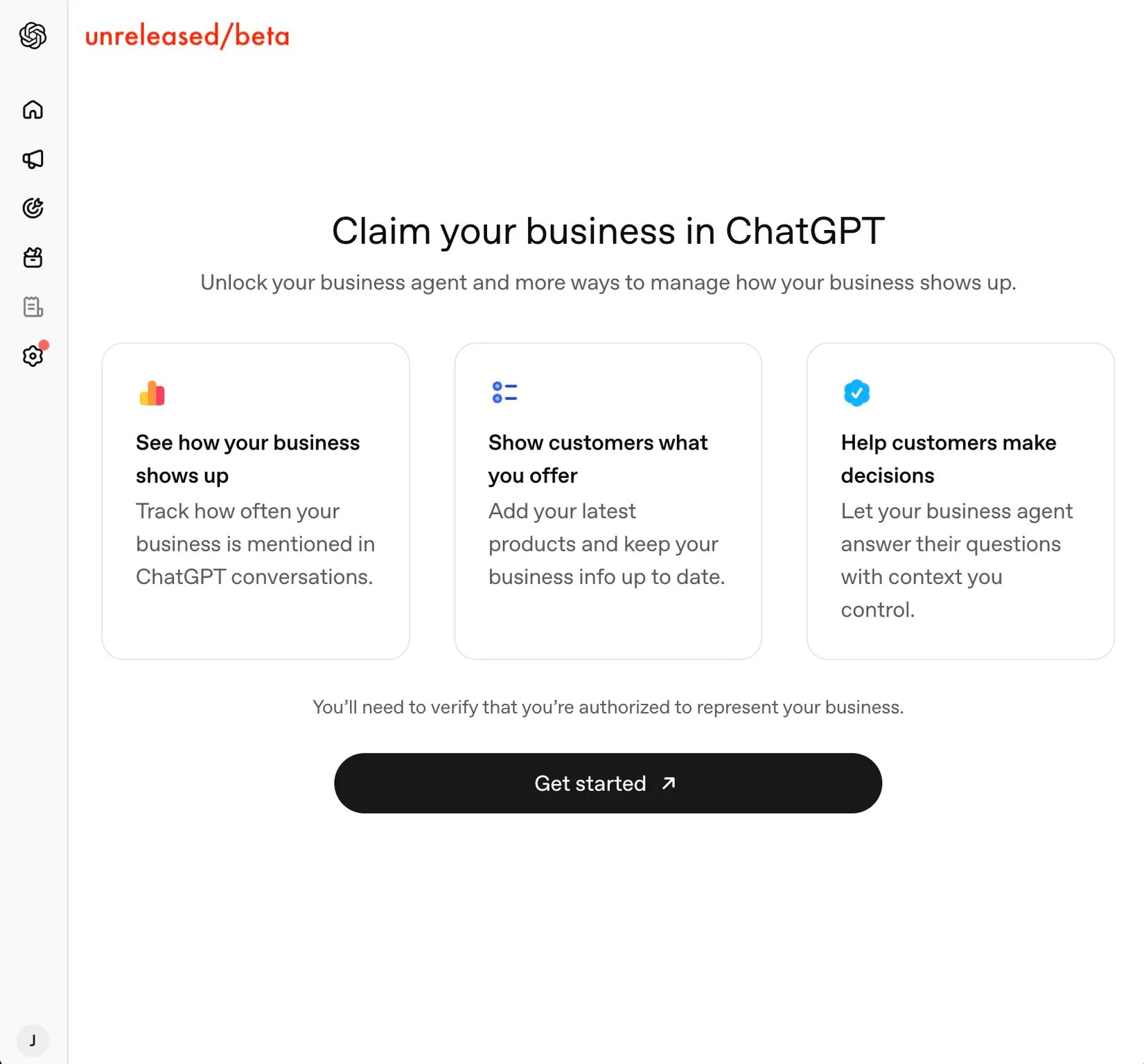
The feature appears to belong to a broader product called Business Hub, where companies would be able to claim and manage how their businesses appear in ChatGPT.
According to the report, the tool would offer three main capabilities:
Track business visibility: See how often your business is mentioned in ChatGPT conversations.
Manage business information: Add products and keep business details updated.
Help customers make decisions: Use a business agent that answers customer questions using business-provided information.
The interface also indicates that businesses would need to verify ownership before gaining access.
Kaziukėnas mentioned connecting a Shopify store as one possible verification method.
He said he first noticed traces of the feature in August 2026, with the November interface suggesting development had progressed.
However, an unreleased interface doesn't guarantee that every displayed feature will launch in its current form.
What Metrics Will ChatGPT Analytics Show?Based on the information shared so far, the analytics dashboard would focus on two primary metrics.
| Metric | What It Measures |
|---|---|
| Business impressions | Number of times a business appears in ChatGPT responses |
| Website clicks | Number of clicks on links leading to the business's website |
Both metrics would reportedly be tracked daily and presented through charts showing changes over time.
This could give marketers a clearer understanding of whether their AI search visibility is improving.
For example, imagine your SaaS company appears in ChatGPT responses 50,000 times in one month and receives 1,000 website clicks.
You could calculate an indicative click-through rate of 2%.
In the following month, your business might appear 80,000 times but receive only 900 clicks.
Your visibility increased, but website engagement declined.
That would raise an important question.
Are you appearing for more informational conversations where users don't need to visit your website, or has something changed in how ChatGPT presents your business?
At the moment, we don't have enough information to answer questions like that.
What the Tool Reportedly Won't Show
Kaziukėnas also said the current version doesn't provide:
The individual prompts responsible for business mentions.
User-level information.
Competitor rankings or visibility comparisons.
That limitation matters.
A business might discover that its ChatGPT impressions increased by 40%, but it wouldn't necessarily know which questions produced the increase.
This is where third-party prompt-tracking platforms could remain useful.
They can monitor selected questions, compare recommendations across competitors, and help explain changes that aggregate analytics alone cannot.
But the potential advantage of OpenAI's tool is that the impressions and clicks would come directly from the platform.
Will ChatGPT Analytics Be Free or Paid?
We don't know yet.
OpenAI hasn't announced whether Business Hub analytics would be free, require a subscription, or become part of another commercial offering.
There's also no confirmation that access would be connected to ChatGPT advertising.
Early reporting suggests the feature is aimed at organic business visibility rather than paid advertising, but that distinction hasn't been officially finalized.
For marketers, pricing will be important.
If OpenAI provides free access to verified businesses, it could become an essential reporting tool for SEO and GEO professionals.
If access requires payment, businesses will need to determine whether the additional data justifies the cost.
Either way, verified first-party impressions and clicks could improve the quality of AI search reporting.
Why Google Is Facing Pressure to Reveal AI Search Click Data
The timing of OpenAI's reported development is particularly interesting because Google is facing similar questions about transparency.
On June 3, 2026, the UK's Competition and Markets Authority imposed new requirements concerning publishers' content in Google Search.
Under those requirements, Google must provide clearer engagement data for content appearing in generative AI search features.
The CMA expects publishers to receive information covering:
Impressions: How frequently their content appears in AI-generated search experiences.
Clicks: How often users follow links to their websites.
Click-through rates: The relationship between impressions and clicks.
Importantly, the CMA expects reporting that distinguishes AI search features from conventional organic search results.
The compliance deadline is December 3, 2026. <Cite refs={["turn249885search5","turn249885search8"]}/>
Why Doesn't Google Search Console Show Separate AI Click Data?
Google Search Console currently includes clicks from AI Overviews and AI Mode within its broader Search performance reporting.
But publishers cannot fully isolate the performance of those experiences from conventional organic results.
This creates a measurement problem.
Imagine your website receives 20,000 clicks from Google Search.
How many came from traditional organic listings?
How many came from AI Overviews?
And how many originated in AI Mode?
Without sufficiently separated reporting, determining how these features influence website traffic becomes difficult.
In early November, Google's Gary Illyes said the company was interested in providing more information but had nothing new to announce.
That statement doesn't establish that Google is deliberately withholding data.
It does show that publishers are still waiting for reporting capabilities that would help them evaluate AI search performance more accurately. <Cite ref="turn341688search12"/>
Could ChatGPT Analytics Change SEO and GEO Reporting?
I think it could, particularly for businesses investing in generative engine optimization.
Currently, much of AI visibility measurement involves testing selected prompts and recording whether a brand appears.
For example, an AI visibility platform might track 100 questions relevant to a company's products.
It could report that the business appeared in 35 of those responses.
That's useful for monitoring a defined set of queries.
But it doesn't tell you how frequently real ChatGPT users encountered the business across all conversations.
A first-party analytics dashboard could help address that limitation.
It could also help marketers evaluate whether increased visibility corresponds with more website clicks.
However, impressions and clicks still don't tell the full story.
Getting Mentioned Doesn't Mean Getting Customers
Suppose ChatGPT mentions your company 100,000 times in a month.
That sounds impressive.
But what happens if those mentions generate only a few hundred visits and no qualified leads?
Is the campaign successful?
That depends on your objectives.
Brand visibility may have value even without immediate clicks. Some users could discover your company through ChatGPT and return later through another channel.
But marketers shouldn't automatically treat citations or impressions as proof of commercial performance.
Getting mentioned isn't the same as getting clicks. And getting clicks isn't the same as acquiring customers.
I've worked on B2B SEO campaigns that generated thousands of signups, and one thing I consistently prioritize is connecting search activity with business outcomes.
That's the standard I'd apply to AI search reporting too.
How Businesses Should Measure AI Search Performance
If ChatGPT launches this tool, I wouldn't recommend abandoning existing analytics platforms.
Instead, I'd combine several data sources to understand the acquisition journey.
| Tool | Main Purpose |
|---|---|
| ChatGPT Business Analytics | First-party business impressions and clicks, if launched |
| AI visibility tracking tools | Selected prompt monitoring and competitor comparisons |
| Google Analytics 4 | Website sessions, engagement, and conversions |
| Google Search Console | Organic Google search performance |
| CRM or sales platform | Qualified leads, pipeline, and customers |
For example, ChatGPT analytics might show that your business received 2,000 website clicks.
GA4 could help you understand the sessions and conversions attributed to ChatGPT referrals.
And your CRM could reveal whether those visitors eventually became paying customers.
You could also include self-reported attribution questions during onboarding, asking customers how they first discovered your business.
No single platform will capture every interaction perfectly.
But combining first-party visibility data, website analytics, and customer acquisition reporting would provide a clearer picture than relying solely on citations.
Is Google Deliberately Withholding AI Search Data?
I don't think there's enough evidence to conclude that.
Google has technical, product, and privacy considerations to address when introducing new reporting capabilities.
But there's also a legitimate concern from publishers.
If Google uses their content to power AI-generated responses, they need enough information to understand how that exposure affects their websites.
That's especially important when AI answers may reduce the need for users to click through to the original source.
The CMA's requirements reflect the importance of transparency in this relationship.
And if OpenAI launches its business analytics tool, it could introduce additional competitive pressure for better AI search measurement.
The irony is that Google already operates one of the most established webmaster analytics products in the industry.
Yet OpenAI may be preparing to offer businesses dedicated reporting on their AI search visibility while Google is still facing questions about separating AI traffic from traditional search data.
Final Thoughts
OpenAI's reported ChatGPT analytics tool could represent an important step toward more transparent AI search reporting.
For the first time, businesses might gain access to platform-reported information showing how often they appear in ChatGPT responses and how frequently users click through to their websites.
But the feature remains unannounced, and questions about pricing, availability, attribution, and reporting limitations remain unanswered.
Meanwhile, Google's December 3 compliance deadline is approaching.
For SEO professionals, the broader direction is encouraging.
We're moving toward a world where AI search performance may be measured with more than selected prompt tests and estimated brand visibility.
But the ultimate goal remains unchanged.
Impressions show visibility. Clicks show engagement. Customers show business value.
And the closer we can connect those three, the better we can evaluate whether AI search is actually contributing to growth.
The question I'm particularly interested in is whether Google will provide genuinely useful AI search click reporting or continue combining much of that activity with traditional organic search.
Do you think Google is deliberately holding back AI search click data, or is there another reason it's taking so long?
Sources and References
Search Engine Roundtable: OpenAI Working on ChatGPT Tools for Business Analytics and Citations, November 6, 2026.
Juozas Kaziukėnas, LinkedIn, original report, November 6, 2026.
UK Competition and Markets Authority: Google Search Publisher Conduct Requirement, June 3, 2026.