
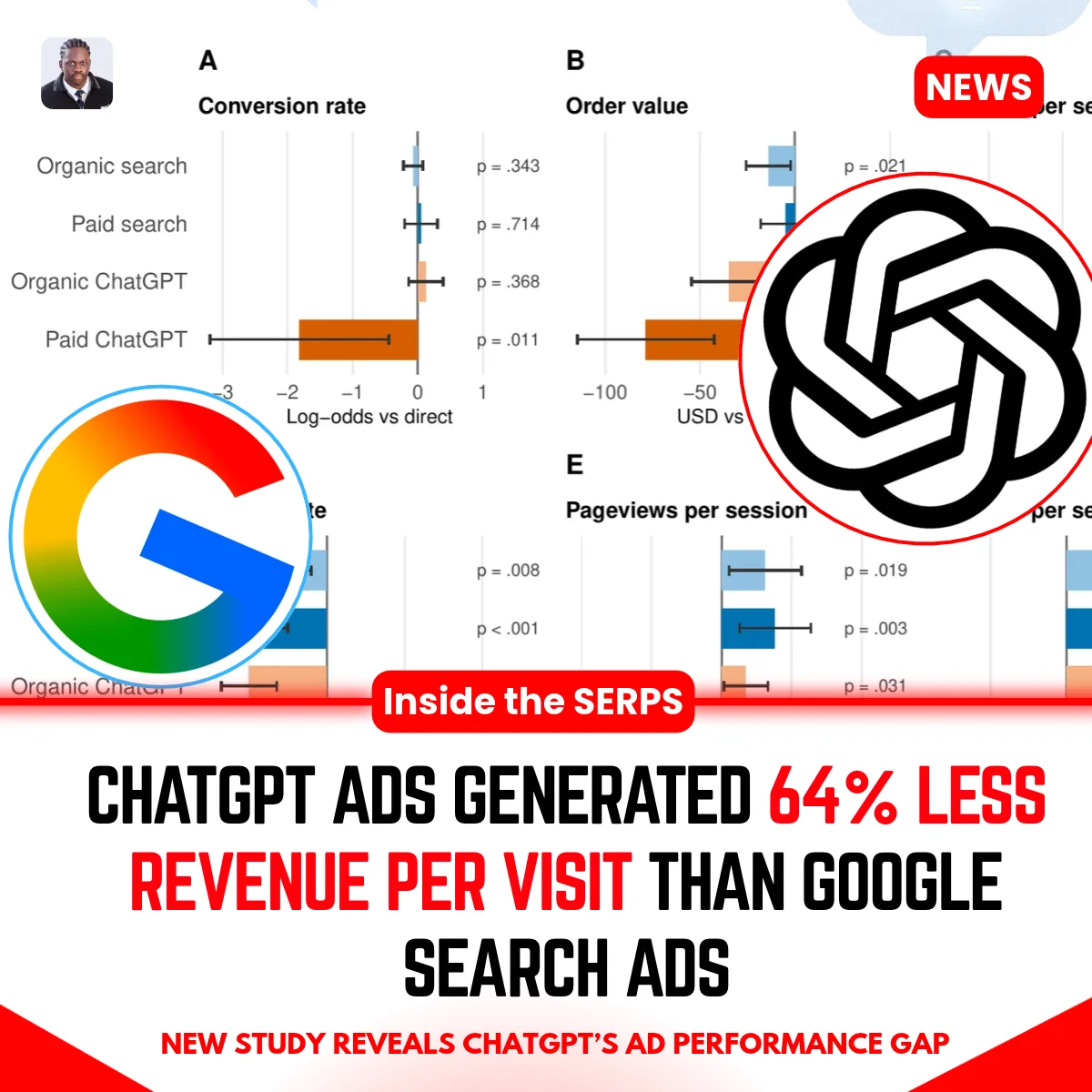
ChatGPT ads generated 64% less revenue per visit than Google Search ads, according to a new study analyzing advertising performance across online retailers.
But there's another number marketers should pay attention to.
$0.26 per click.
That's approximately what researchers estimated a ChatGPT ad click would need to cost to deliver the same return on advertising spend as Google Search ads.
For context, one publicly disclosed ChatGPT advertiser reported paying $1.72 per click, more than six times that estimated benchmark.
That doesn't mean every ChatGPT advertiser pays $1.72, or that $0.26 is the ideal CPC for every business.
However, the comparison raises an important question.
Are marketers paying a premium to reach users on a new advertising platform without sufficient evidence that those clicks generate comparable business value?
A new working paper by researchers from WU Vienna and Frankfurt School of Finance & Management provides some early answers.
And if you're considering moving part of your Google Ads budget into ChatGPT advertising, the findings deserve attention.
ChatGPT Ads vs Google Ads: What the Study Found
The October 2026 working paper, Can Advertising Fund Free AI? Evidence from ChatGPT's International Advertising Rollout, was authored by Maximilian Kaiser and Christian Schulze.
The researchers analyzed nearly 10 billion website sessions across 1,898 online retailers over 60 weeks, from June 2025 through August 2026.
The study examined how ChatGPT's advertising rollout affected referral traffic, conversions, and advertiser revenue.
The overall dataset was substantial, but the direct paid advertising comparison used a smaller sample of 102 websites with complete sales tracking.
Here's how ChatGPT advertising compared with Google Search advertising for US traffic.
| Performance Metric | ChatGPT Ads | Google Search Ads |
|---|---|---|
| Revenue per visit | $0.89 | $2.45 |
| Conversion rate | 0.37% | 1.17% |
| Average order value | Approximately $240 | Approximately $209 |
| Revenue disadvantage | 64% lower | Baseline |
| Estimated ChatGPT CPC for ROAS parity | $0.26 | Comparison benchmark |
Source: Kaiser and Schulze, October 2026 working paper. Figures represent observed US advertiser traffic, not platform-wide averages.
The results are particularly interesting because ChatGPT shoppers had a higher average order value.
Yet fewer visitors completed purchases.
That lower conversion rate more than offset the larger average purchases, leaving ChatGPT ads with substantially less revenue per visit.
However, these results shouldn't be interpreted as proof that ChatGPT advertising cannot work.
The paper is observational, remains under review, and reflects a specific sample of online retailers during an early stage of the advertising platform.
ChatGPT Ads Generated $0.89 Per Visit vs Google's $2.45
Let's examine the revenue difference.
According to the study, a visitor arriving through a ChatGPT advertisement generated approximately $0.89 in attributed revenue.
A visitor arriving through a Google Search ad generated approximately $2.45.
That's a difference of $1.56 per visit.
Or roughly 64% less revenue for ChatGPT advertising.
To understand what this means, imagine two campaigns each generating 10,000 website visits.
Using the study's observed averages:
| Campaign | Visitors | Revenue per Visit | Estimated Revenue |
|---|---|---|---|
| ChatGPT Ads | 10,000 | $0.89 | $8,900 |
| Google Search Ads | 10,000 | $2.45 | $24,500 |
Under these illustrative conditions, Google Search would generate $15,600 more attributed revenue from the same number of visits.
Of course, revenue per visit doesn't tell us everything.
We still need to know how much each advertiser paid to acquire those visitors.
A channel generating less revenue per visit could still be profitable if its clicks were sufficiently cheaper.
That's why the cost-per-click findings are particularly important.
Why Researchers Estimated ChatGPT Ads Should Cost $0.26 Per Click
One of the most useful findings in the paper is the estimated CPC required for ChatGPT ads to match Google Search's return on advertising spend.
The researchers calculated a parity price of approximately $0.26 per ChatGPT ad click.
In simple terms, this is the estimated amount advertisers could pay for a ChatGPT click while achieving a comparable advertising return to Google Search, given the performance and cost data used in the analysis.
However, the largest publicly disclosed ChatGPT advertising account at the time reportedly paid $1.72 per click.
That's approximately 6.6 times the estimated parity price.
This is a comparison between a modeled benchmark and one publicly known advertiser's costs.
It isn't evidence that every advertiser is overpaying by the same amount.
Still, it illustrates why advertisers should be careful about allocating budgets based on the excitement surrounding a new platform.
A low-converting channel can be commercially worthwhile.
But its acquisition costs must reflect the value of the customers it generates.
The important metric isn't how cheap or expensive a click appears. It's how much business value that click produces relative to its cost.
ChatGPT Ads Also Had a Lower Conversion Rate
The study found that ChatGPT ad visitors converted at 0.37%, compared with 1.17% for Google Search ads.
That means Google Search's observed conversion rate was approximately 3.2 times higher.
Why might this happen?
One possible explanation is the difference between the intent behind a search query and the intent behind a conversational interaction.
When someone searches Google for "buy running shoes online," their purchasing intent may be relatively explicit.
They are looking for a product and may already be ready to buy.
ChatGPT conversations can involve many different activities.
Someone might be researching a product, exploring options, learning about a topic, or casually asking for recommendations.
Even when an advertisement is relevant, the user may not be ready to make a purchase.
This is a plausible interpretation, not a causal explanation established by the study.
Conversion performance could also depend on advertising placement, targeting, campaign maturity, landing pages, and the retailers included in the sample.
There's another important finding.
Among 87 advertisers using both ChatGPT and Google Search advertising, 73 recorded no purchases from their paid ChatGPT visits during the observed period.
And one advertiser accounted for a substantial majority of the ChatGPT-attributed purchases.
That concentration makes the average performance figures particularly sensitive to individual advertisers.
It's another reason businesses should test the platform using their own conversion data rather than assuming the study's averages will apply to them.
Does This Mean ChatGPT Advertising Is a Bad Investment?
Not necessarily.
I wouldn't use this study to conclude that every business should avoid ChatGPT ads.
Instead, I'd treat it as evidence that the platform's early advertising performance deserves closer examination before marketers shift substantial budgets away from established channels.
There are several limitations worth understanding.
First, this is a working paper. The research is under review and shouldn't be treated as a final, universally established conclusion.
Second, the paid advertising sample is much smaller than the overall dataset. Although the researchers analyzed nearly 10 billion sessions, the main paid revenue comparison involved 102 websites with full financial tracking.
Third, the study focuses on online retail. Results may differ for B2B SaaS, professional services, financial products, and businesses with longer sales cycles.
Fourth, attribution is incomplete. The researchers measured revenue attributed to website visits. Purchases occurring later or through another channel may not be fully captured.
And finally, the study measures an early period in the development of ChatGPT advertising.
Advertising products can change as platforms improve targeting, placements, measurement, and advertiser tools.
That doesn't guarantee performance will improve.
But it means the findings are best understood as an early benchmark rather than a permanent verdict.
What About Organic ChatGPT Traffic?
Interestingly, the researchers also examined what happened to unpaid ChatGPT referrals after advertising was introduced.
The study estimated that organic ChatGPT referrals declined by approximately 5.9% during the first 13 weeks following ad launches, compared with markets without advertising.
However, that initial estimate was not statistically significant.
After adjusting for assumed differences in regional ChatGPT growth, the estimated decline increased to approximately 7.2% to 8.4%.
Those adjusted results were statistically significant under the researchers' assumptions.
The study also found no meaningful change in the conversion rate of the remaining organic ChatGPT referrals.
This suggests advertising may have affected the volume of unpaid referrals without substantially changing how those remaining visitors converted.
However, the adjusted results depend on the assumptions used.
It's also important not to confuse organic ChatGPT referrals with paid ChatGPT advertising.
They represent different acquisition experiences and may attract users with different intentions.
A strong organic AI referral conversion rate doesn't automatically mean paid advertisements on the same platform will perform equally well.
Should You Move Your Google Ads Budget to ChatGPT?
My position is fairly simple.
A new advertising channel can be worth testing without being worth replacing an existing one.
I've seen marketers argue that businesses should shift spending toward AI because it's the future of search.
But the future of a platform doesn't automatically establish the return on investment available today.
Google Search advertising already gives businesses access to users expressing intent through specific search queries.
If your existing campaigns generate qualified leads, profitable purchases, or strong customer acquisition economics, moving that budget elsewhere introduces an opportunity cost.
You could be sacrificing a channel with demonstrated performance to experiment with one that hasn't yet proven comparable returns for your business.
That doesn't mean you should ignore ChatGPT advertising.
It means experimentation should be deliberate.
How I'd Evaluate ChatGPT Advertising Before Scaling
I'd begin by establishing the performance of existing acquisition channels.
For an e-commerce business, the key metrics might include cost per acquisition, conversion rate, average order value, contribution margin, and return on advertising spend.
For B2B SaaS, I'd focus on qualified leads, demo-to-customer conversion, customer acquisition cost, pipeline value, and customer lifetime value.
Then I'd run a controlled ChatGPT advertising test using a limited experimental budget, without immediately removing spending from profitable Google campaigns.
The test should have clearly defined success criteria.
For example, how much can the business afford to spend acquiring one customer?
What conversion rate would make the campaign sustainable?
How much qualified pipeline would justify increasing the investment?
These questions should be answered before launching the campaign.
Otherwise, it's easy to declare success because the ads generated clicks, even when those clicks produced little commercial value.
Why Revenue Matters More Than Clicks or AI Visibility
This research also reinforces something I've argued about SEO and AI visibility.
Marketers often become excited about new channels before connecting their performance to actual customer acquisition.
We saw similar discussions around generative engine optimization, ChatGPT citations, and AI search referral traffic.
A brand might appear frequently in AI-generated responses without receiving meaningful traffic.
And it might generate traffic without acquiring customers.
The same problem applies to paid advertising.
A campaign generating 10,000 clicks isn't necessarily better than one generating 1,000.
What matters is the commercial value of the visitors and the cost of acquiring them.
I've helped a B2B company generate thousands of signups through SEO, and I've also worked on improving visibility and acquisition through AI search.
One lesson that consistently matters is the distinction between attention and business outcomes.
Impressions and citations are useful indicators.
Clicks tell us whether people are visiting.
But signups, qualified leads, customers, and revenue tell us whether an acquisition strategy is producing business value.
This is why I'd rather see a marketing team invest in reliable attribution and conversion tracking before moving significant spending into another platform.
Without those systems, how would you even know whether the switch worked?
How to Measure ChatGPT Ads ROI Properly
Before comparing advertising channels, make sure you're measuring them consistently.
At a minimum, I would track:
| Metric | What It Tells You |
|---|---|
| Cost per click | How much you're paying for traffic |
| Conversion rate | How many visitors take a valuable action |
| Cost per acquisition | What it costs to acquire a customer |
| Revenue per visit | How much attributed revenue each visit generates |
| Return on ad spend | Revenue generated relative to advertising costs |
| Customer lifetime value | Long-term value of acquired customers |
Revenue per visit is useful, but it isn't the same as profitability.
Likewise, ROAS doesn't account for every operating cost.
For businesses with longer buying cycles, I would also connect advertising data to the CRM and examine how leads progress through the sales pipeline.
That helps avoid undervaluing channels that influence purchases occurring weeks or months after the initial interaction.
No attribution model captures every customer journey perfectly.
But a consistent measurement framework makes channel comparisons considerably more useful.
Final Thoughts: Test ChatGPT Ads, But Don't Ignore the Economics
The October 2026 research provides an interesting early picture of ChatGPT advertising.
Paid ChatGPT visitors generated $0.89 in revenue per visit, compared with $2.45 for Google Search ads.
Their conversion rate was also substantially lower.
And the estimated $0.26 CPC required to match Google Search's advertising return raises questions about the prices some early advertisers have paid.
But these findings don't establish that ChatGPT advertising will always underperform Google.
The study is observational, the paid comparison sample is limited, and the platform is still evolving.
For marketers, the lesson isn't to avoid emerging advertising channels.
It's to evaluate them using the same commercial standards applied to established ones.
If ChatGPT ads can generate customers at an attractive acquisition cost, they're worth considering.
If Google Ads is already generating profitable customers, there should be a compelling reason before reducing that investment.
"AI is the future" isn't a financial model.
A new channel should earn a larger share of your marketing budget through demonstrated performance, not excitement alone.
And if you don't know how much each customer is worth or what you're currently paying to acquire them, that's the problem I'd solve first.
Sources and References
Kaiser, M., & Schulze, C. (2026). Can Advertising Fund Free AI? Evidence from ChatGPT's International Advertising Rollout. Working paper, October 2026, under review.
Search Engine Land: ChatGPT Ads Generate 64% Less Revenue per Visit Than Google Search, November 2, 2026.
Search Engine Journal: Google Search Ad Visits Out-Earned ChatGPT Ads in the US, November 2, 2026.