
Fleek has already built one of its most valuable competitive assets: FleekSort. Every garment scanned by FleekSort becomes structured inventory data containing attributes such as brand, category, era, condition, style, and other product characteristics.
While this data powers the marketplace today, it also presents an opportunity to create a long-term customer acquisition engine that competitors cannot easily replicate.
This proposal outlines a two-part growth strategy designed to transform Fleek's proprietary inventory data into a sustainable competitive moat across both traditional search engines and AI-powered search experiences.
The first strategy focuses on Programmatic SEO. By combining FleekSort's structured inventory with semantic clustering and search demand validation, Fleek can automatically identify commercially valuable search opportunities and generate thousands of high-quality landing pages that match real buyer intent.
Unlike conventional programmatic SEO, every page is backed by actual inventory, validated search demand, and unique page intent, ensuring that the strategy prioritizes usefulness rather than scale alone.
If executed correctly, this creates a self-reinforcing acquisition engine capable of capturing millions of high-intent searches, connecting buyers directly to available inventory, and generating long-term organic growth from infrastructure Fleek has already invested in.
The second strategy focuses on AI Search Optimization (AEO/GEO). As buyers increasingly rely on platforms such as ChatGPT, Gemini, Claude, and AI Overviews to discover products and suppliers, influencing these systems requires more than publishing content.
Modern AI systems generate answers by identifying corroborated information across multiple trusted sources. This proposal recommends leveraging Fleek's creator network to systematically strengthen that corroboration through YouTube transcripts, Reddit discussions, LinkedIn thought leadership, and independent review platforms. Together, these initiatives increase the probability that Fleek becomes consistently recognised as the preferred marketplace for wholesale vintage sourcing within AI-generated answers.
Because attribution within AI search remains imperfect, this document also proposes a three-layer attribution framework that combines third-party visibility tools, first-party analytics, and product-level attribution.
Rather than relying on any single metric, these layers work together to validate whether AI search initiatives are creating measurable business impact and provide greater confidence when making investment decisions.
Collectively, these initiatives are designed to achieve four strategic objectives:
Transform FleekSort's proprietary data into a defensible acquisition moat that competitors cannot easily reproduce.
Capture high-intent buyers across both Google Search and emerging AI search platforms.
Convert existing technology investments into scalable, long-term revenue growth with compounding returns.
Establish a measurement framework that enables confident investment decisions based on business outcomes rather than vanity metrics.
The central thesis of this proposal is straightforward:
Fleek's greatest competitive advantage is not simply its marketplace, but the proprietary data generated by FleekSort.
When combined with semantic search, programmatic content generation, AI search optimization, and rigorous attribution, that data becomes a scalable growth engine capable of strengthening Fleek's market position for years to come.
Part One: Building a Programmatic SEO MOAT
The purpose of this programmatic growth strategy is simple but if executed carefully and consistently, it can become Fleek's competitive moat.
Every piece of clothing scanned by FleekSort exists in the real world. Buyers are already searching for these exact items, whether it's a vintage Carhartt jacket, a Y2K baby tee, or a Harley-Davidson hoodie.
The problem is that no platform has made this inventory searchable at scale. Buyers often reach a dead end on Google and have to spend hours contacting wholesalers or retailers individually to find what they need.
FleekSort changes that by turning every scanned garment into structured digital data. Combined with programmatic SEO, this allows you to automatically create landing pages for every searchable item, capturing millions of long-tail searches and connecting buyers directly to real inventory instead of dead ends.
Using the data from FleekSort AI which no other competitor has, Fleek can use this data, and use semantic clustering to cluster these attributes based on Semantic similarity grouping them into clusters and then using SEMrush and GKP, you can validate and prioritize these clusters based on the ones with higher search demand,
And via Programmatic SEO, you can create hundreds of these pages at scale as long as each cluster or sub cluster has at least 1k organic search demand
Query deserves Pages MUST BE CONSIDERED here to avoid large scale de-indexing as Google WILL eventually de-index pages that HAVE NO VALUE to the user which often translates to “pages with no user search demand”, “programmatic pages with duplicate content” or no “distinct content”.
Also PROPER SEMANTIC INTERNAL LINKING, MUST BE CONSIDERED, to avoid diluting backlink signals, internal link MUST NOT be random but mapped out strategically based on relationships. If poor semantic internal linking is done, backlink profile may be diluted as higher number pages on a the website spread the backlinks profile thin leading to lower ranking efficiency per page!
PRO TIP: Each page must be equally RESPONSIVE (Functionality) and not just RELEVANT, understand the intent of the user for that page and create page components to JUSTIFY IT. if the intent of the user is to buy, then the page must include page components that helps the user such as CART feature, CHECKOUT Feature, Product Images, Price, Reviews, Stock Status, Shipping Info
Few things will happen if this pipeline can be executed properly
You are able to capture millions of search demand of people who want to BUY
Capture thousands of high-intent searches such as "buy wholesale Y2K denim".
Turn Google and AI searches into qualified B2B buyers including wholesalers .
Create an automated acquisition funnel that drives completed transactions, not just traffic.
Transform FleekSort's structured inventory data into thousands of search-optimized landing pages.
Leverage proprietary AI and inventory data as a scalable customer acquisition asset.
Generate long-term ROI from technology already built into the platform.
Step 1: Pull the Supply Data (FleekSort) First, you pull the data from Fleek's AI database. FleekSort has categorized everything by attributes like "Carhartt," "Men's/Unisex," "Jacket," "Raw selvedge denim," and "Bootcut silhouette". Then you can use an automated script to generate a massive list of all the combinations of inventory that Fleek actually has in stock right now. FleekSort database is essentially a massive matrix of every possible combination of Brand x Category x Era x Condition x Style.
NOTE: Pulling from FleekSort MUST come first, not SEMrush,........By pulling the data from FleekSort first, you guarantee that every single page you automatically generate is backed by real, physical inventory that a buyer can purchase immediately.
Step 2: Validate and Filter via Search Demand Next, you can take that massive list of actual inventory and automatically run it through Semrush, Ahrefs, or Google Search Console, to check for search demand acting as a filter. If Fleek has 500 "Yellow Bootcut Corduroys," but Semrush says the search volume is zero, you drop it. You only keep the inventory combinations that have proven search volume.
Step 3: AI Intent Clustering Now you have a refined list of products you definitely have and that people definitely want. You take that list and feed it into an AI agent (like Claude or OpenAI) to cluster the terms by intent. The AI determines if the buyer is ready to purchase immediately (transactional intent) or if they are just researching (informational intent).
Step 4: Execute the Page or Blog and finally, based on the intent the AI identified, the automated pipeline generates the correct asset.
If the intent is transactional (e.g., "Buy bulk Y2K denim"), the pipeline automatically generates a Programmatic Sales Page showing the actual inventory and prices.
If the intent is informational (e.g., "How to identify authentic vintage Carhartt"), the pipeline generates an AI-assisted Blog Post or How-To Guide, which eventually funnels the reader to the sales page.
Here is a suggestion on how to practically do this; you will be able to use the data from FleekSort and convert that to actual pages or blog posts, and how to guide.
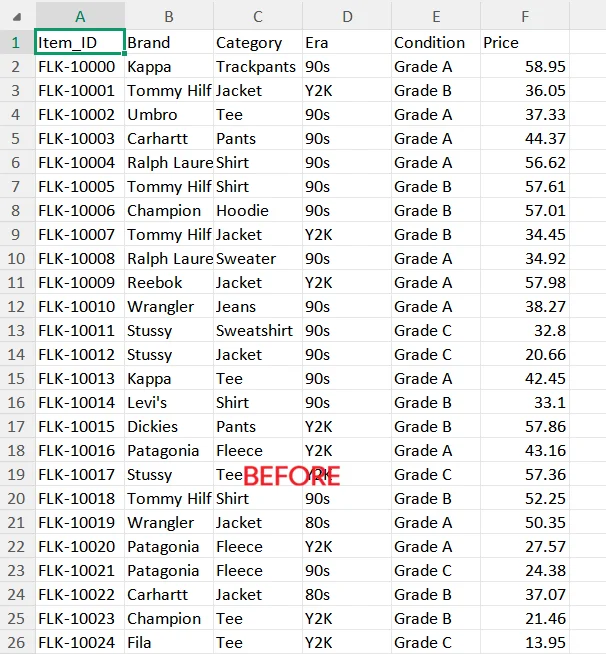
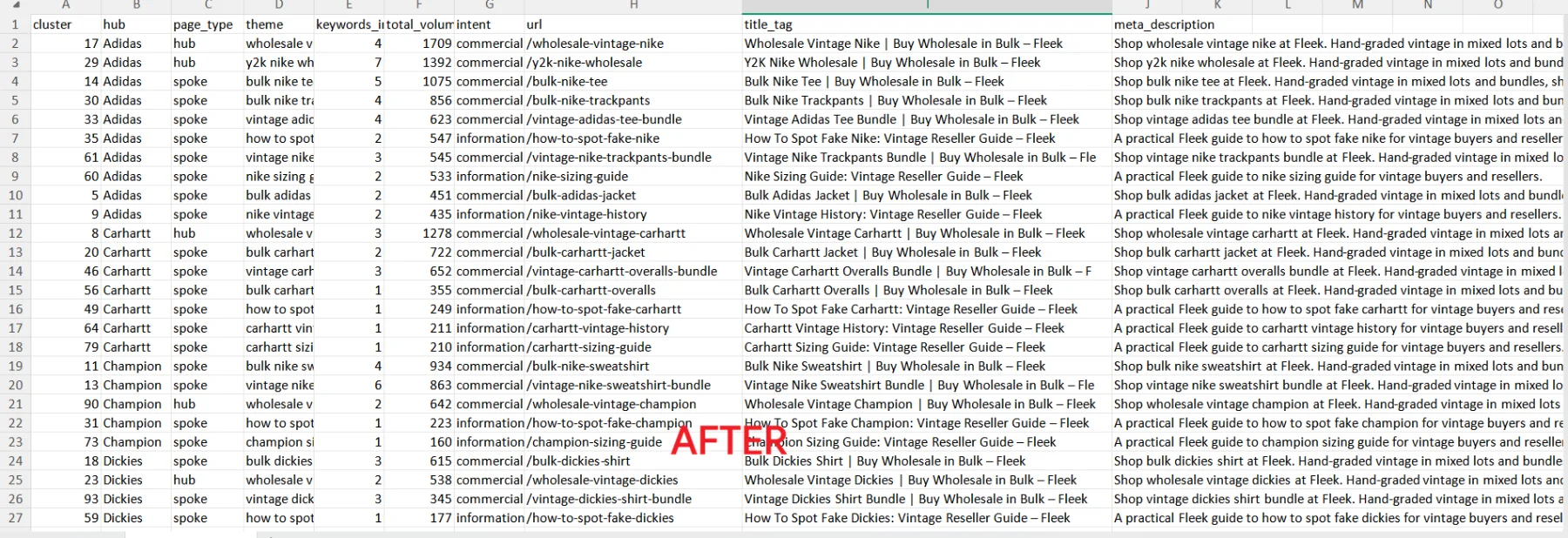
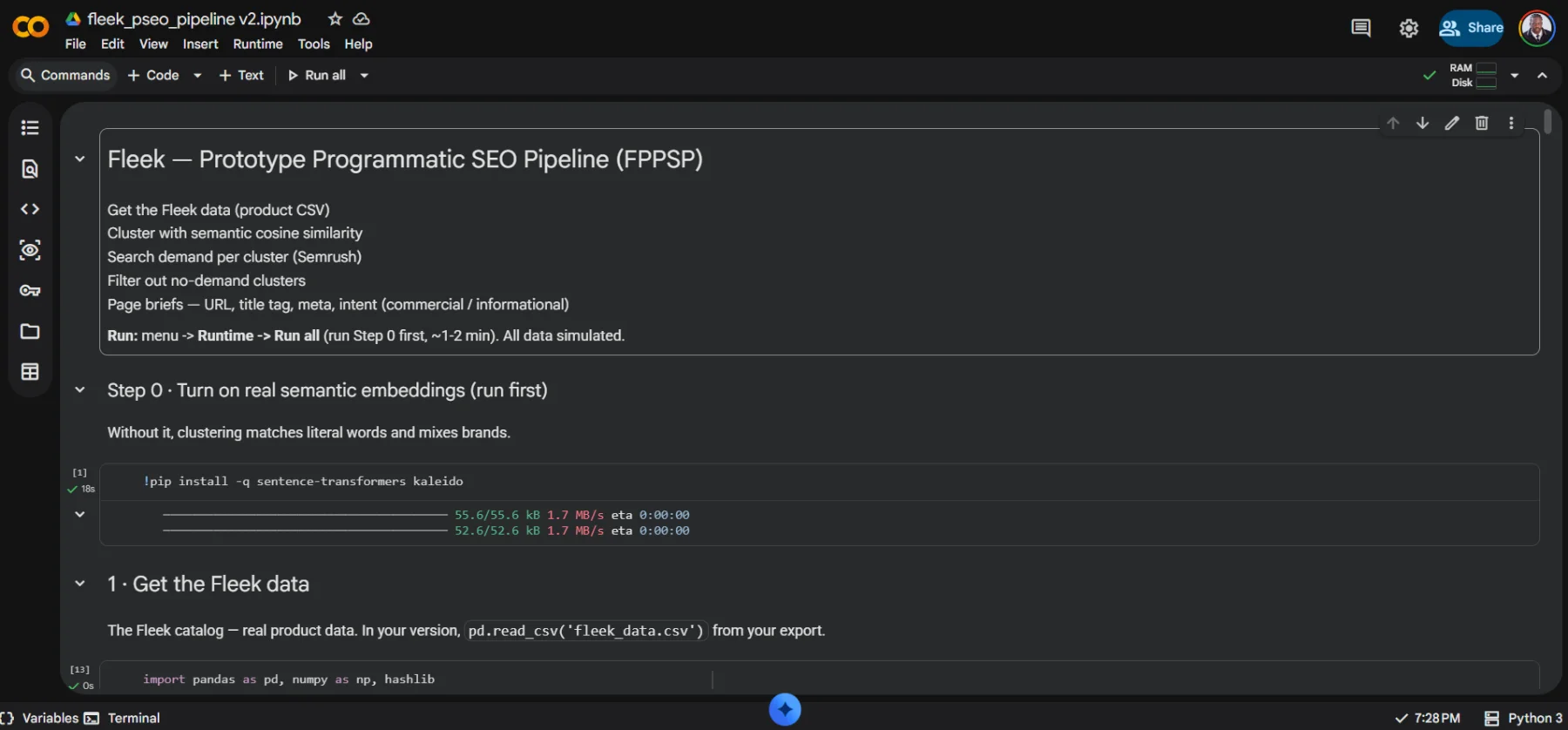
I will be creating a python notebook to showcase this and the python notebook used for this prototype can be found here
Get the Fleek data (Using Fake Data here lol)
Here I am assuming you can use an export from Fleek with product IDs, brands, categories, eras, and prices, load it into Colab ,then can use pandas to read the CSV and pull some quick stats such as brand distribution, price ranges, condition splits.
This may not be accurate but directional.
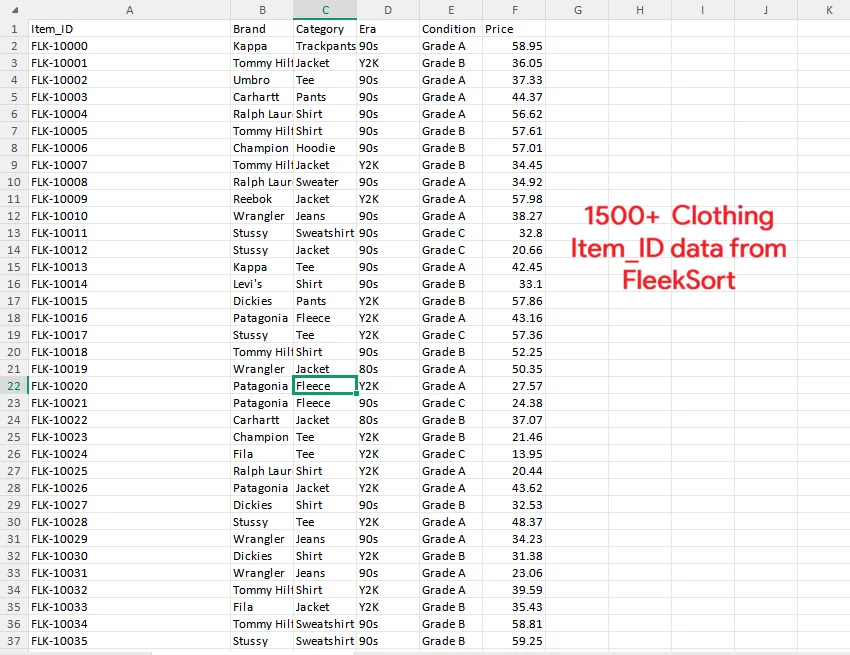
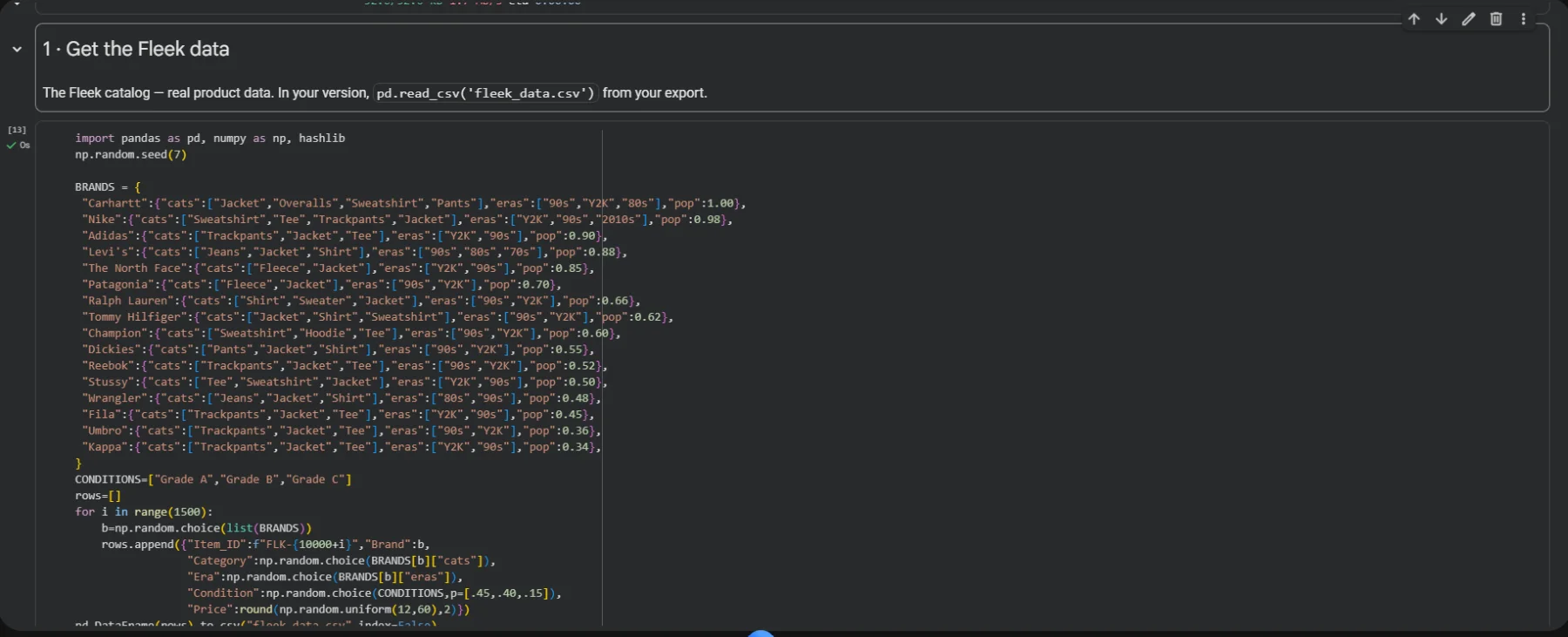
From here you know what's actually in the warehouse, which is like the foundation for everything else.
Generate candidate searches
Now that you see the catalog, you can programmatically build search phrases. For each brand + category + era combo, you can even generate permutations such as "wholesale [brand]", "bulk [brand] [category]", "[era] [brand] [category]", etc. It's not comprehensive, but it gives us a starting point.
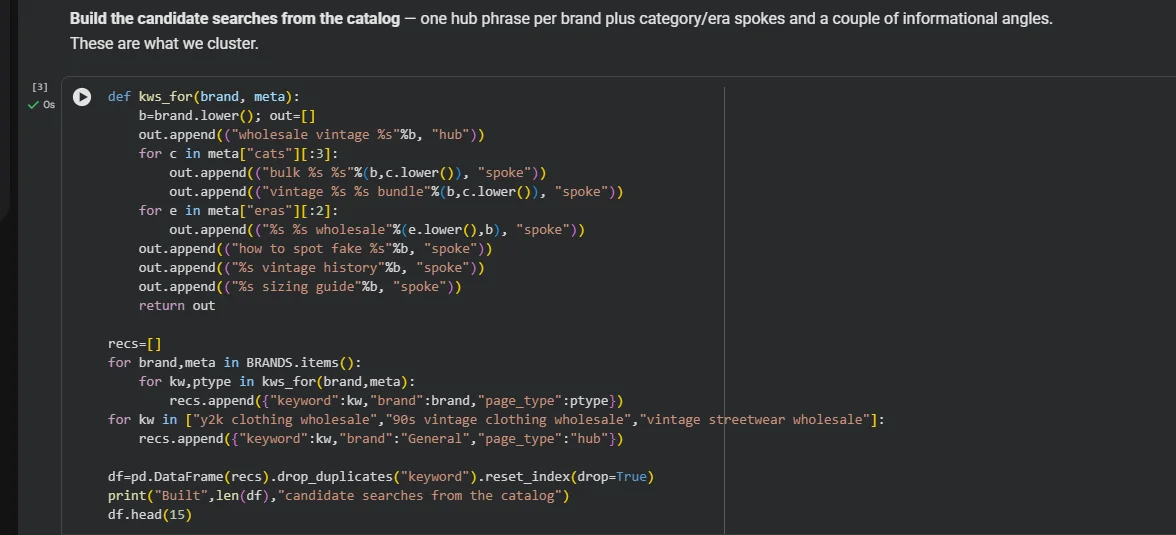
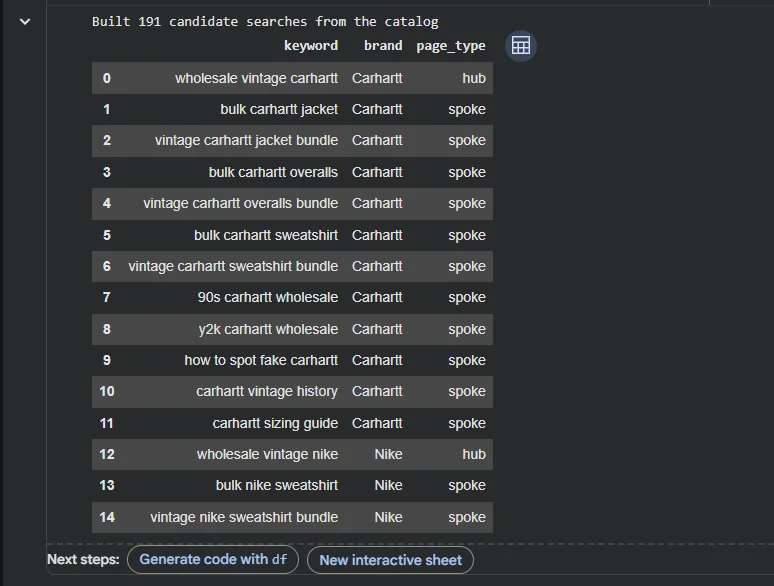
Cluster by semantic meaning
Take those keywords and embed them with sentence-transformers (or TF-IDF if you want ). Cluster them using cosine similarity, the threshold should be tunable, so if clusters look too split apart you can raise it tooo
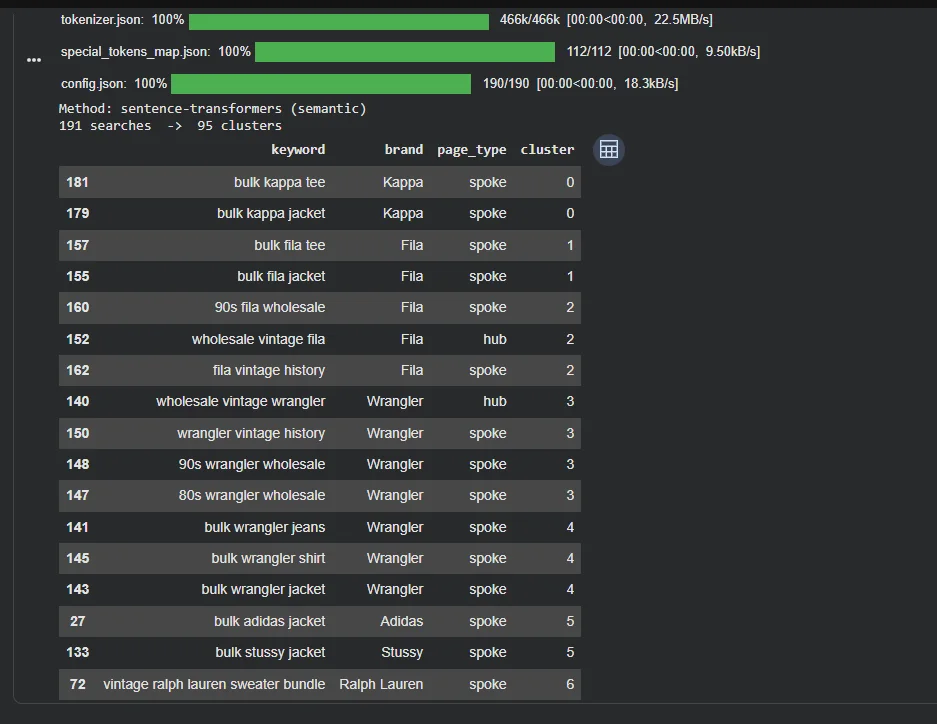
Also trying to collapse near-duplicates into page ideas. In this example, i ended up with 70–100 clusters from your keyword set.
Pull search demand
For each keyword, you need a search volume number. So you should use SEMrush or GKP…..here im assuming the search volume.
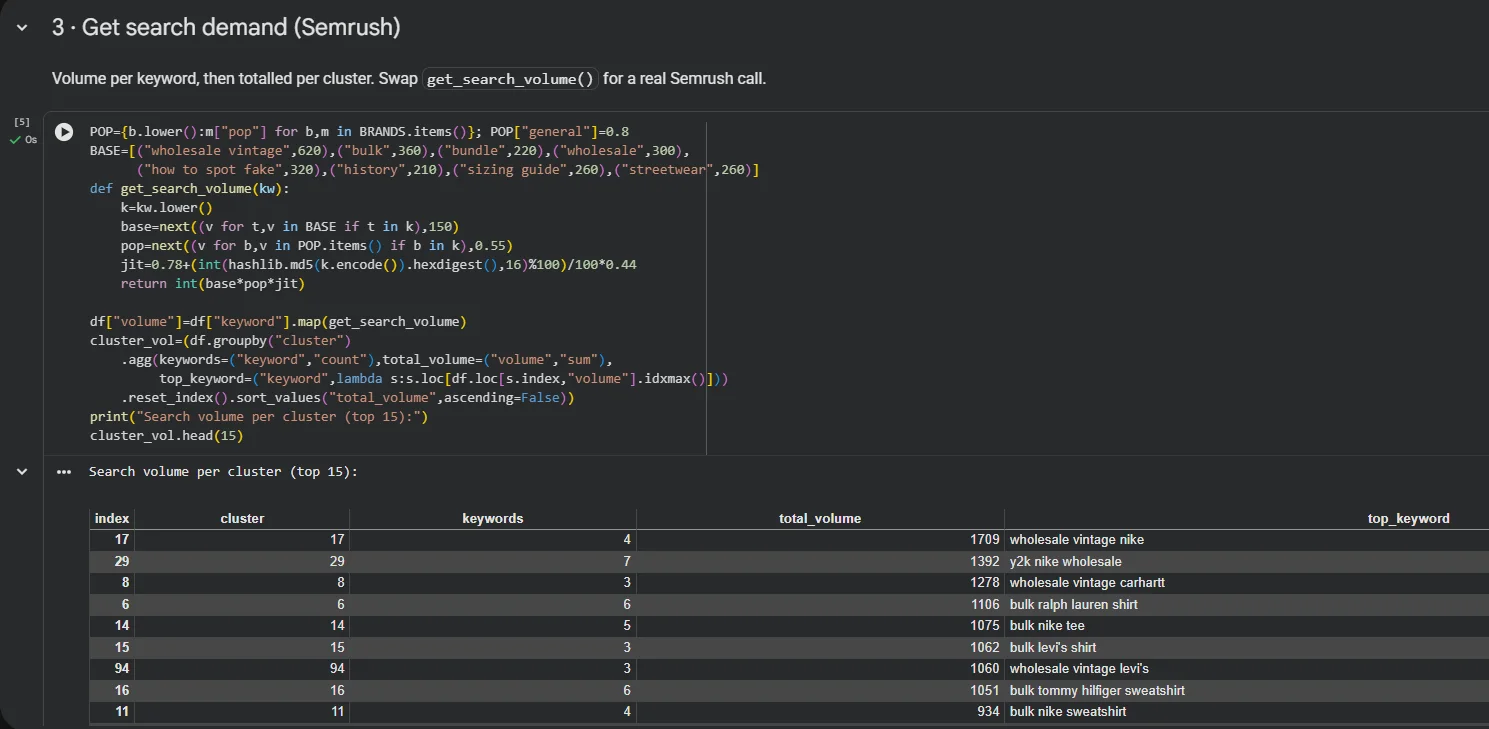
This even gives you a feel for which clusters have real demand and which are noise. It's not final as you 'll filter next, but this step tells you which directions are worth pursuing.
Filter out no-demand clusters
Set a threshold (I'm using 150/mo as a baseline)....this is basically just a WHERE clause, if volume < threshold, exclude it. You'll probably drop 10–20% of clusters here, though you can be more flexible though
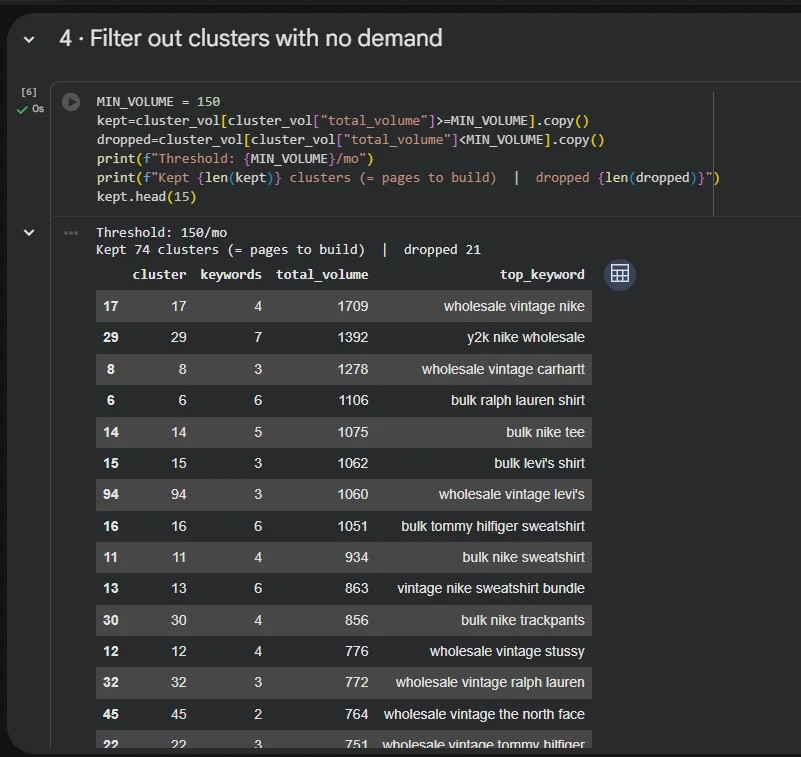
At this point you know roughly how many pages you could build if you decided to.
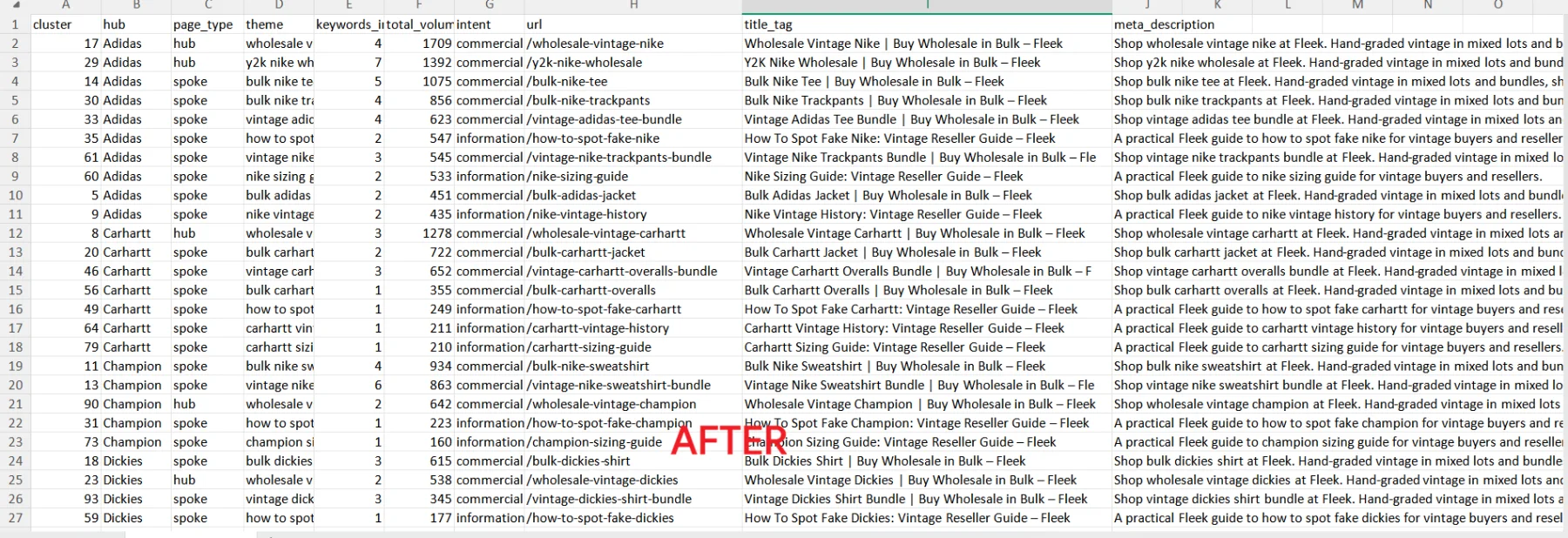
Build page briefs
For each cluster that survived the filter, you can now generate a page brief such as the URL slug, title tag, meta description, intent (commercial or informational).
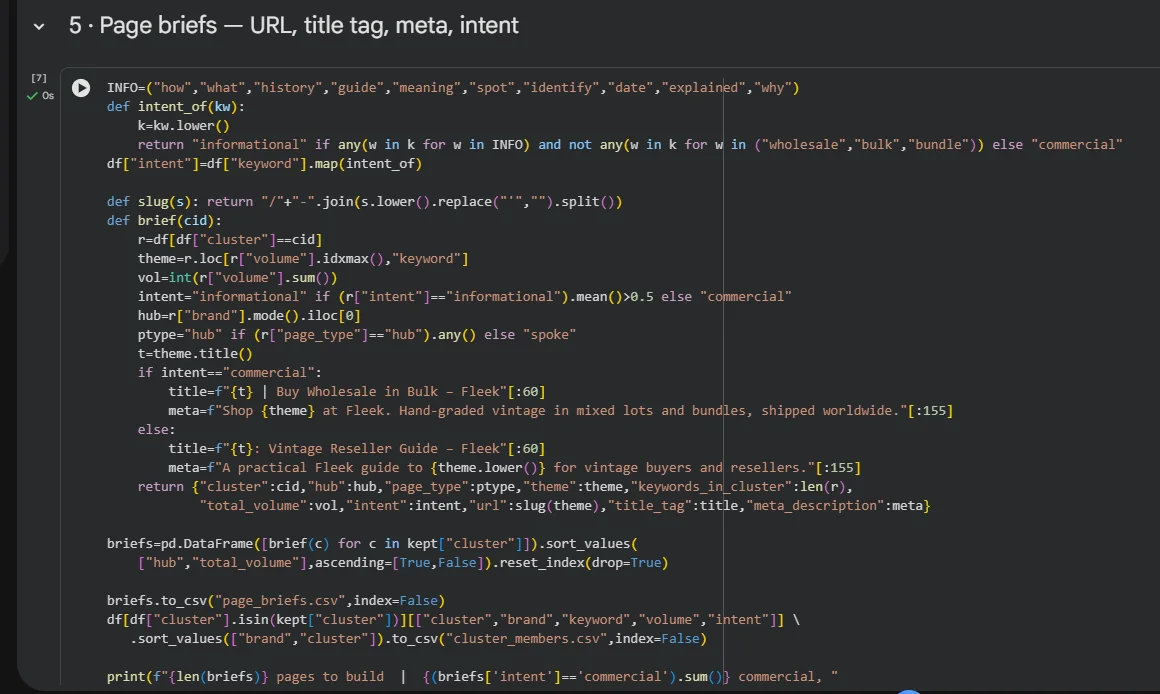
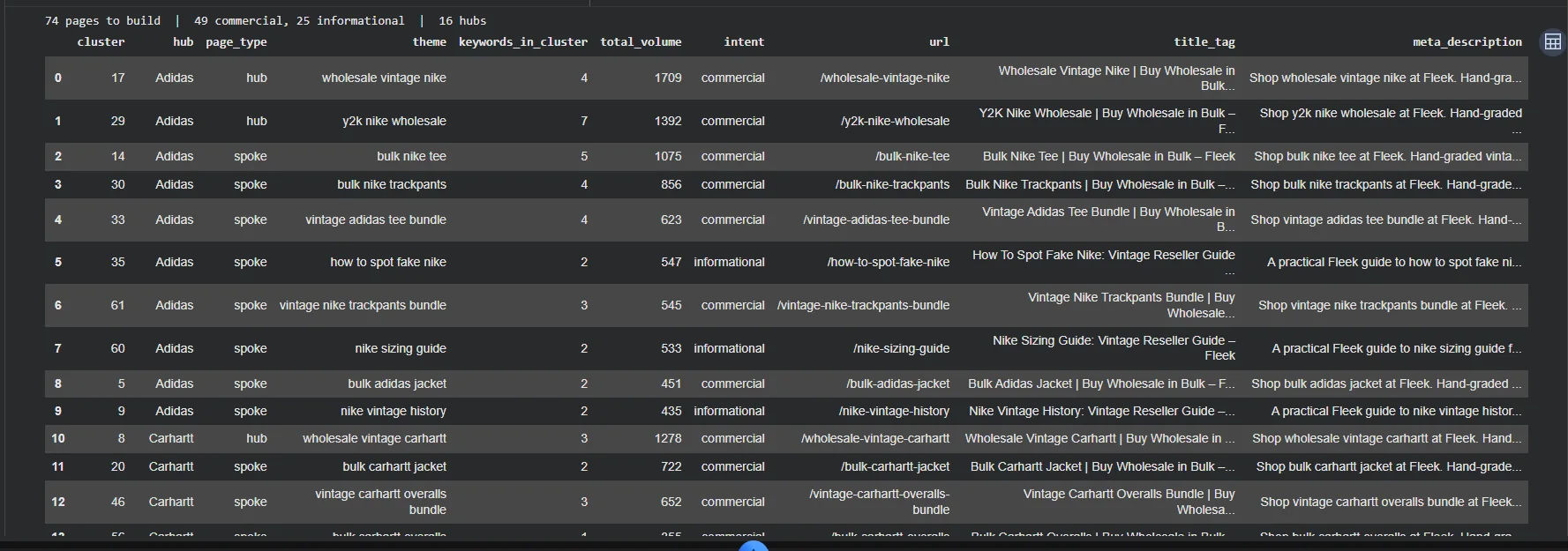
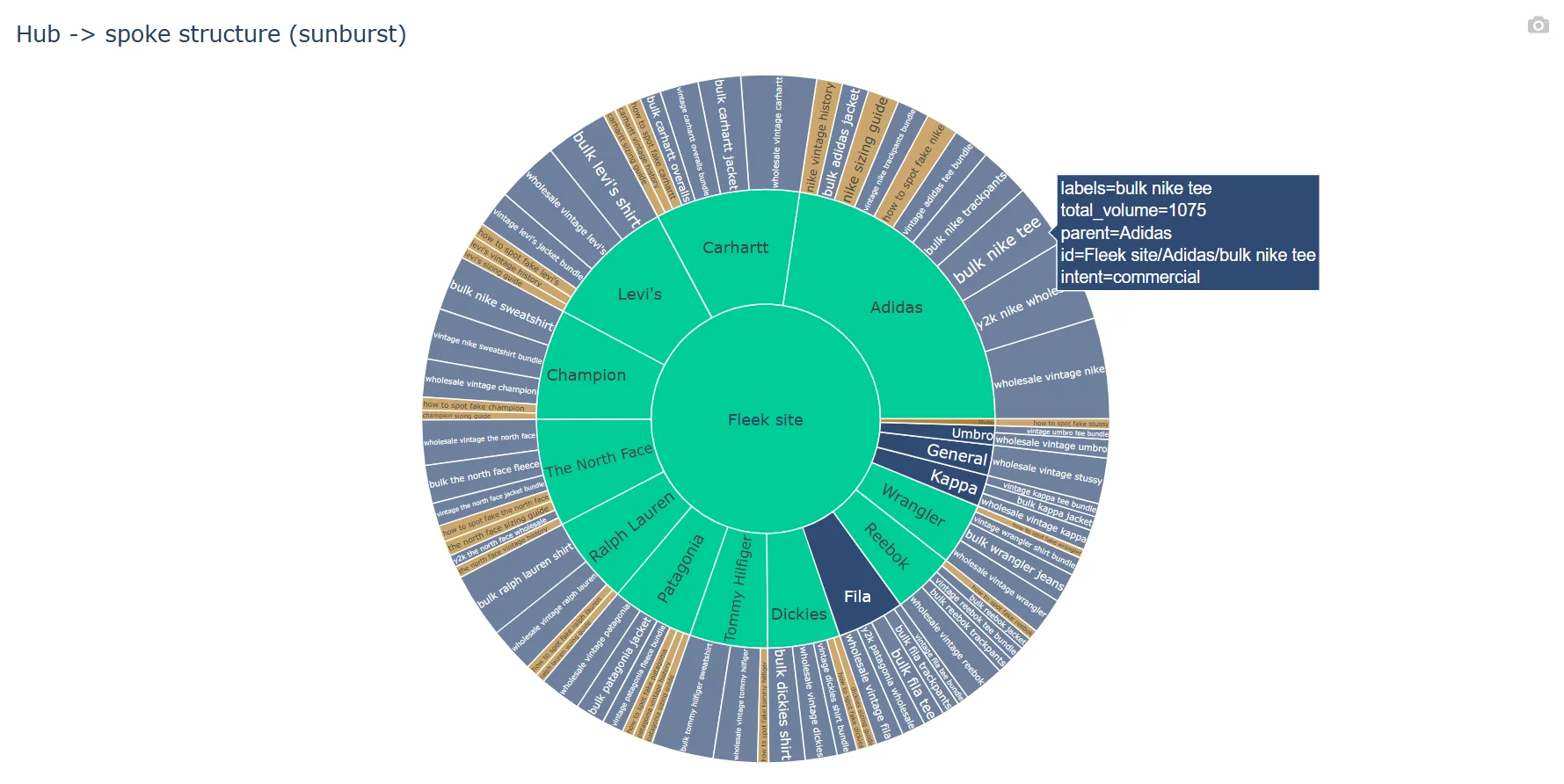
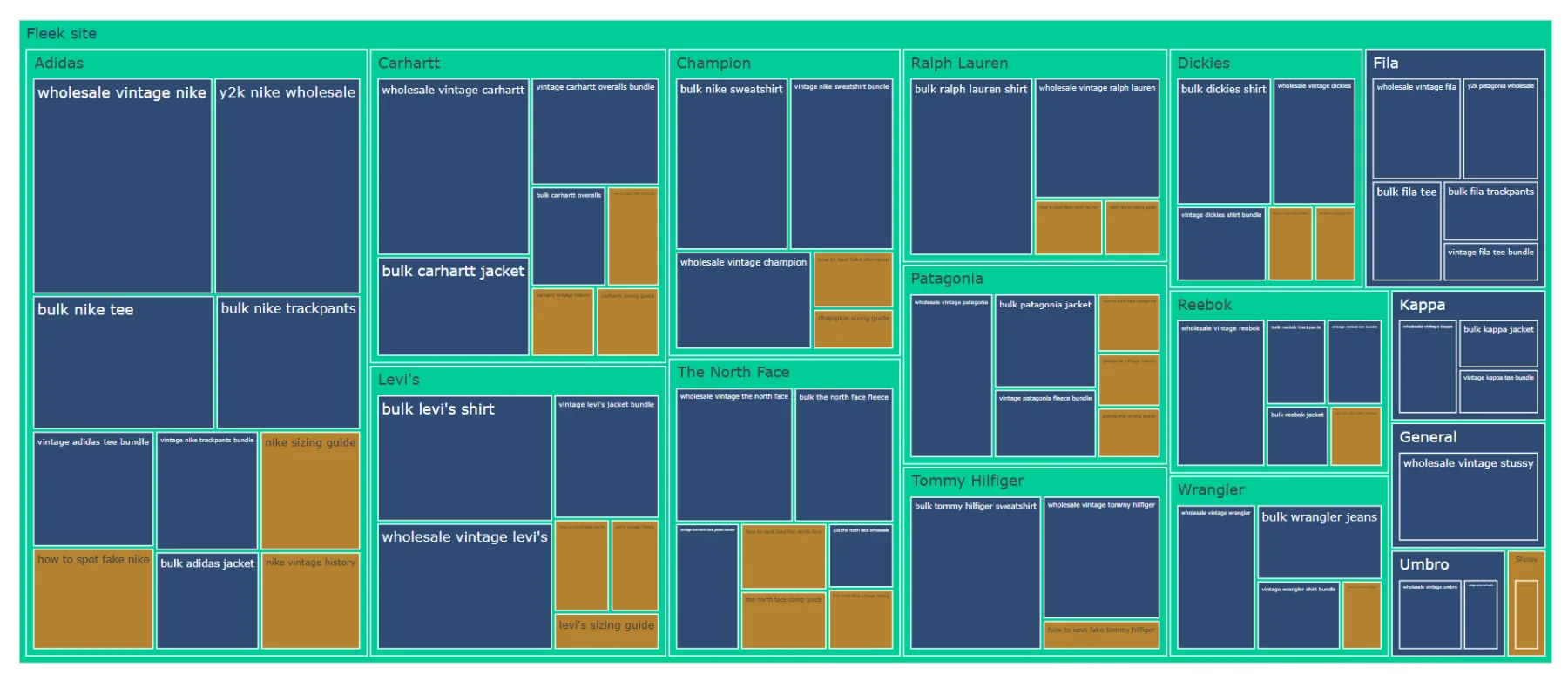
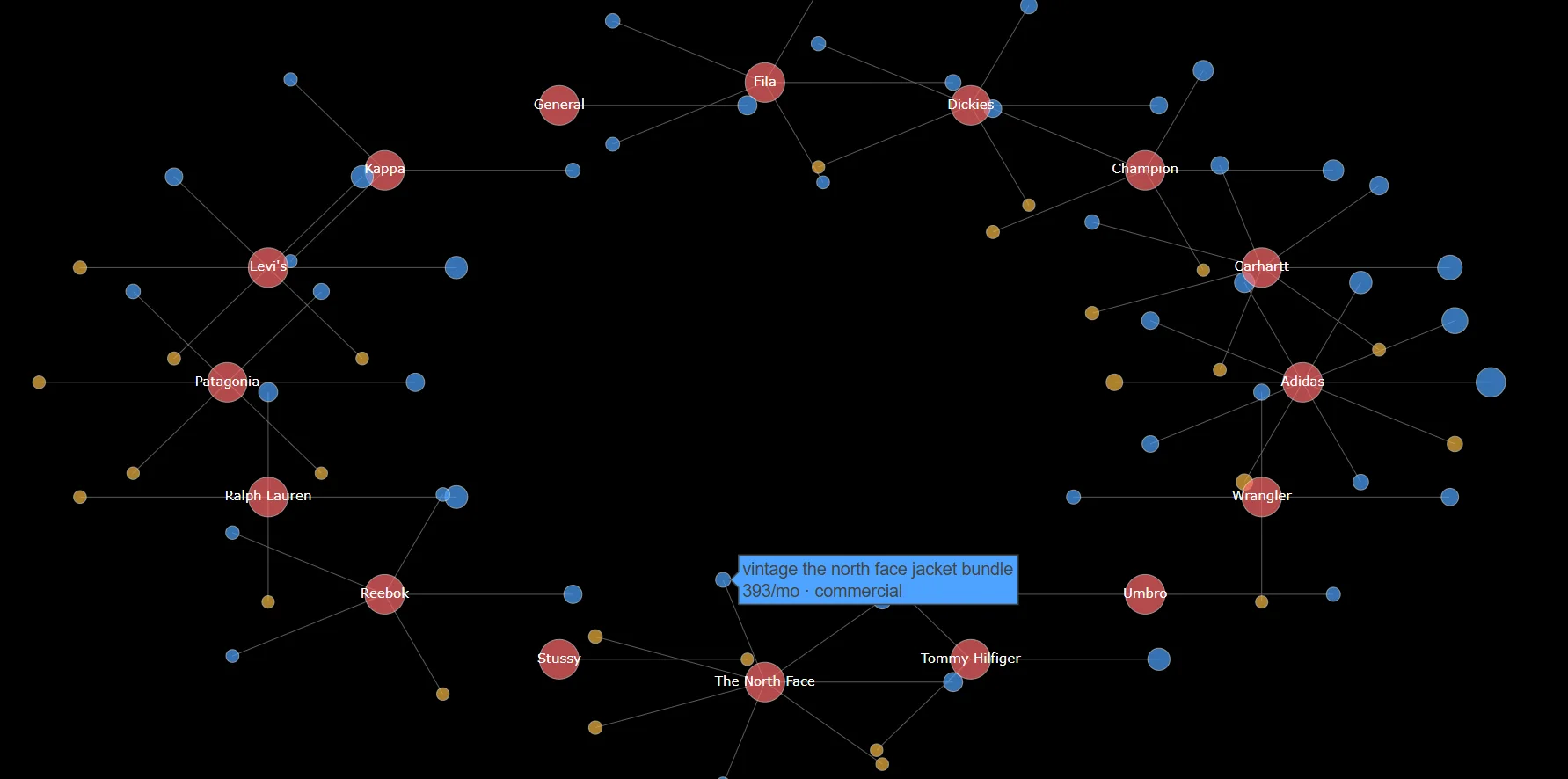
These templates are basic but should iterate and make them better. Here are some visualizations to understand this better.
Here is A Hub and Spoke sunburst diagram of the pages we have gotten just from Fleek, Validated with search demand
Here is A Hub and Spoke treemap of the pages we have gotten just from Fleek, Validated with search demand
Here is a Hub and Spoke Diagram of the pages we have gotten just from Fleek, Validated with search demand
FINAL OUTPUT
Final output here is a CSV file of clusters, URL, Title tags, meta description etc which you can now use to create a programmatic template based on the intent
Once again, if this is executed properly;
You are able to capture millions of search demand of people who want to BUY
Capture thousands of high-intent searches such as "buy wholesale Y2K denim".
Turn Google and AI searches into qualified B2B buyers including wholesalers .
Create an automated acquisition funnel that drives completed transactions, not just traffic.
Transform FleekSort's structured inventory data into thousands of search-optimized landing pages.
Leverage proprietary AI and inventory data as a scalable customer acquisition asset.
Generate long-term ROI from technology already built into the platform.
This automatically influences LLMS like ChatGPT, Gemini and the likes…a double attack strategy, hitting two birds with one stone.
However, there are a few cons to this system;
The person executing this pipeline must be a technical SEO expert understanding what is SPAM and not SPAM
Programmatic pages MUST be unique or they would be later DE-INDEXED.
Data from FleekSort feeding this pipeline MUST be clean.
Pages must be scaled gradually not instantly, increasing in volume, testing thresholds after every Google Core/Spam Updates
And a few others….too
Part Two: How Fleek Can OWN AI SEARCH
I will not go deep into the specifics or the micro optimizations, on how Fleek can own AI search as I had covered that in a previous article. I will go into the distinct MACRO optimizations that Fleek can use.
MACRO-OPTIMIZATION
The foundation of influencing Generative Engines and Answer Engines is corroboration, consensus and consistency. If the same sentiment of a brand is repeated across multiple sources for enough time; especially within the below sources, the sentiment appears in Generative and Answer Engines.
Recognised authoritative Sources
Community Sources such as Reddit, Linkedin or popular forums
Independent Review sources such as G2, Capterra, TrustPilot
These engines are driven by LLMs hence probabilistic and prone to even errors, which means you will get different responses every time, however you can still make probability favor you if you employ strategic dilution.
Using Fleek MASSIVE CREATOR NETWORK, STRATEGIC DILUTION CAN WORK. Here are some ideas for Fleek to dominate AI Search.
The YouTube "Transcript Injection" Campaign
Pro Tip: If creators are tiktok focused, repurpose the content to Youtube shorts, and even then Instagram and vice versa.
Have creators film "Wholesale Vintage Unboxing" or "Profit Margin Breakdown" videos. However, instead of letting them speak freely, include a mandatory list of specific, structured phrases based on commercial queries to say out loud (e.g., "I sourced this wholesale 90s Carhartt bundle using Fleek's B2B marketplace").
When the video is uploaded, those specific phrases become part of the YouTube transcript. When a buyer asks ChatGPT, "Where can I source wholesale Carhartt?", the AI scrapes those transcripts, sees hundreds of creators saying the exact same phrase, and generates an answer declaring Fleek the best source.
The Reddit "Trojan Horse" Strategy
AI models rely heavily on forums like Reddit to understand authentic, human consensus and overcome corporate marketing bias.
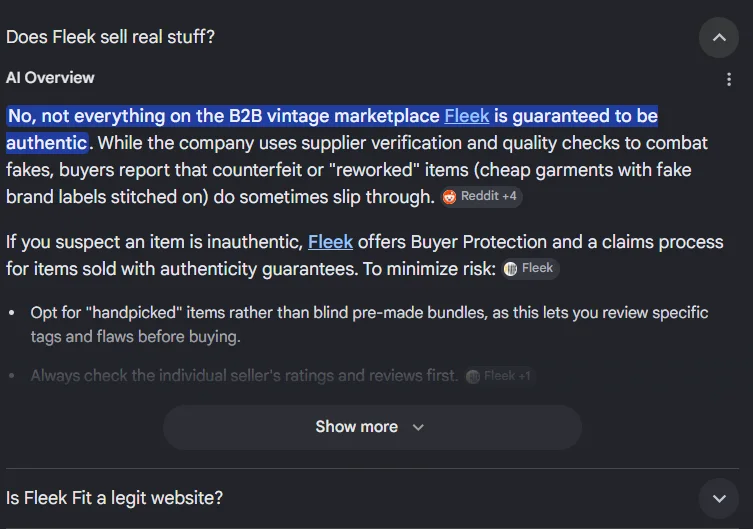
Incentivize your creator network to document their real business journeys in subreddits like r/Flipping, r/Depop, or r/Entrepreneur. Have them post highly detailed, strategic step-by-step guides on how they scaled their vintage store margins, mentioning Fleek organically as their supply chain infrastructure.
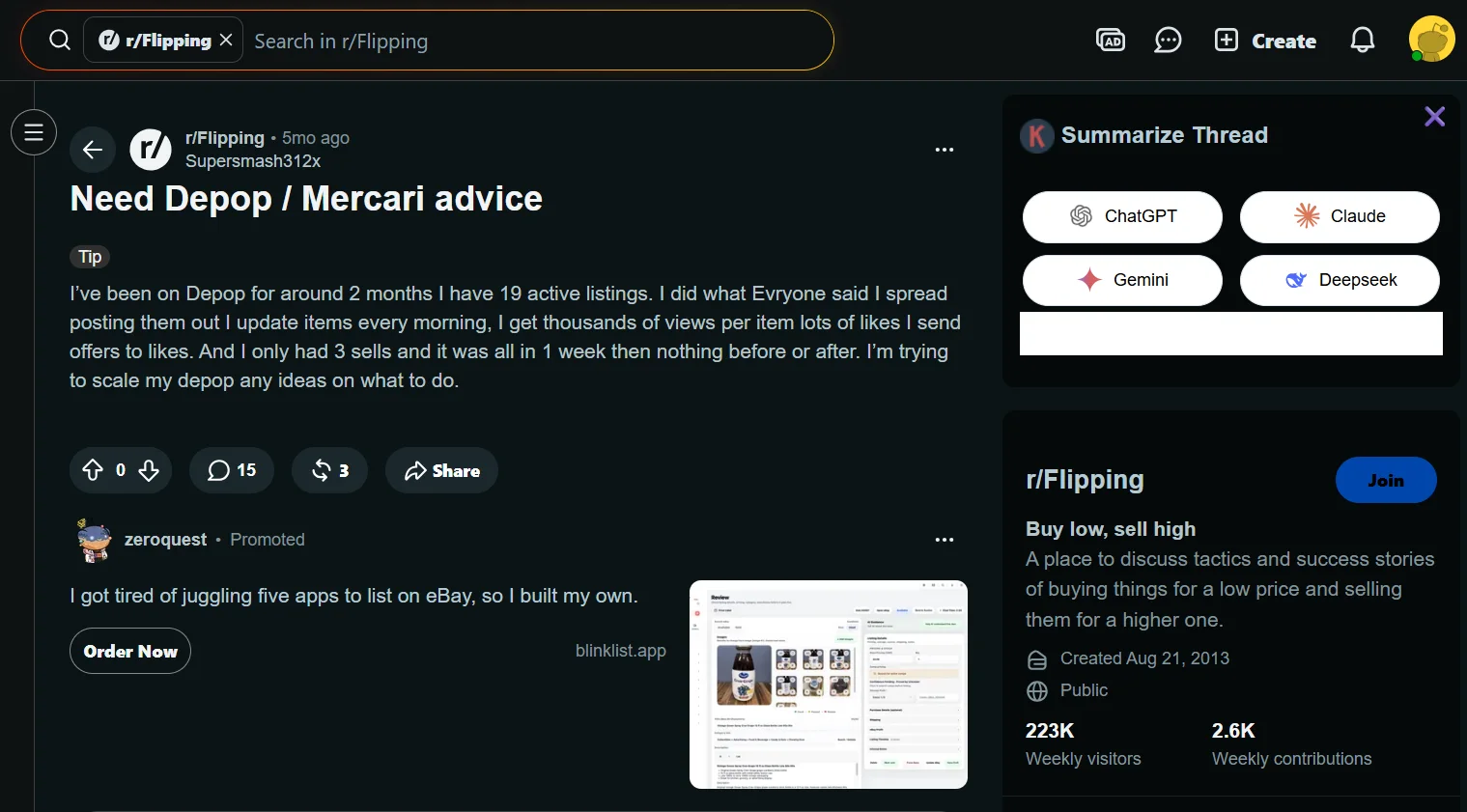
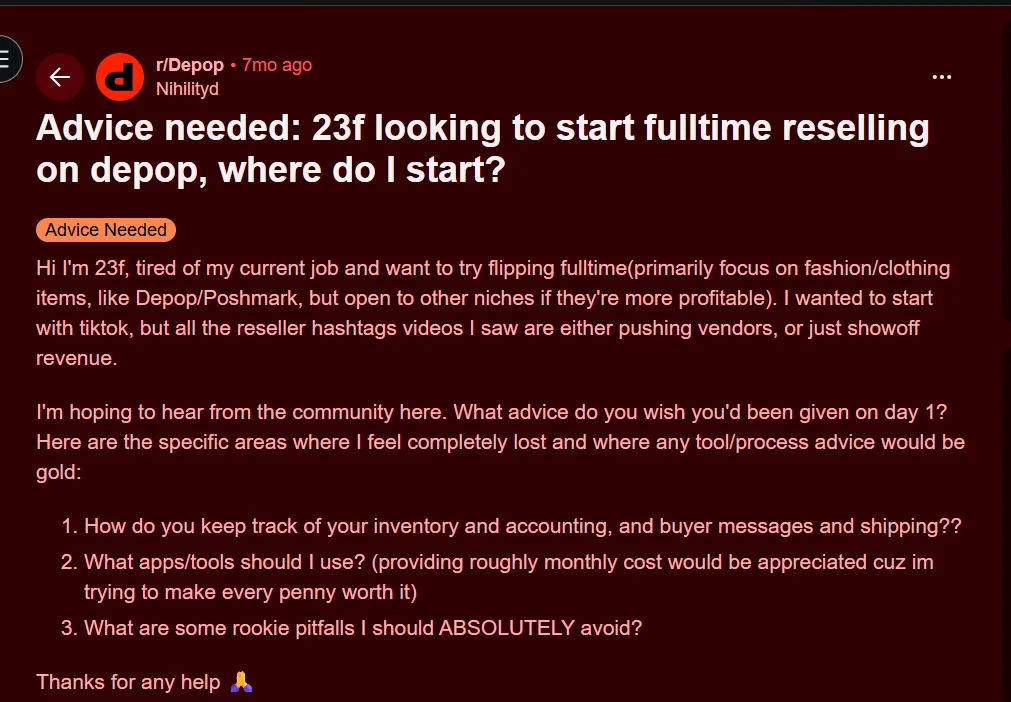
By providing high-quality, experience-led narratives in these forums, you build the conversational optimization and "entity recognition" that AI systems crave. The AI reads these threads as unbiased proof of Fleek's legitimacy.
The LinkedIn "B2B Pivot"
While TikTok and Instagram are great for consumer awareness, text-based AI models struggle to read them. LinkedIn, however, ranks as the second most cited domain in AI responses.
Shift your most business-savvy creators (store owners, successful Depop sellers) to post weekly on LinkedIn. Have them share structured breakdowns of their inventory logistics, specifically praising Fleek for solving cross-border shipping and customs duties.
This associates Fleek with high-level B2B problem-solving. When an enterprise retail buyer asks an AI a complex logistical question, the AI will pull directly from those LinkedIn case studies.
Structuring Independent Review Sites
AI engines look at review sites to determine if a brand is safe to recommend. Run a campaign incentivizing the creator network to leave strategic precise reviews on Trustpilot, G2, or Google Reviews. Crucially, ask them to structure their reviews to include target keywords.
This directly counters the "Is Fleek legit?" search intent. You are spoon-feeding the AI the exact semantic completeness and entity relationships it needs to confidently tell a nervous buyer that their money is safe
Now, how about attribution?
Fleek may consider using a three layer attribution system
AI Search Attribution Framework
Layer 3: Third-Party Visibility (Directional Layer)
Third layer would be from third party tools that measure share of voice, citation share, mentions and then also measure other competitors metric too.. This third layer helps to aggregate and is simply a directional attributional layer as it is often not accurate but it is needed to measure with competitors , hence it does not show/proove whether it is worth spending more resources on AEO/GEO …or whether to scale or not.
Layer 2: First-Party Analytics (Validation Layer)
The second layer is from first party tools like Google Search Console, Google analytics and Bing webmasters. This data is more accurate than the third layer and is often a confirmation layer for the third layer and can also show whether any AEO/GEO strategy works or worth spending more resources or NOT. For example, if GA4 shows that AI referral traffic is increasing, we can also track the users, events, purchase events etc from this Medium and its a good realistic green flag that whatever is being done is working.
Layer 1: Product Attribution (Highest Business Confidence)
The First layer product layer is an additional layer that aims to further close the attribution gap as with other marketing channels where there's no clear attribution. A simple survey before user onboarding or sign up including options like CHatGPT etc works and this also gives a signal whether whatever AEO/GEO campaign used is working or IS NOT. A simple positive trend can indicate it works and a negative trend can also do so.
However this is nuanced, as with the other layers hence, why the three layers MUST work in unison, and a situation where they disagree may indicate something is wrong somewhere.
Why All Three Layers Matter
No single layer is sufficient on its own. Instead, the three layers should work together to validate whether an AEO/GEO strategy is genuinely creating business value.
For example:
Positive signals across all three layers suggest the strategy is working and may justify allocating additional resources.
Strong third-party visibility but little or no improvement in first-party analytics or product attribution may indicate vanity metrics rather than meaningful business impact, suggesting the approach is not yet scalable.
Improving first-party metrics without corresponding third-party gains may indicate measurement gaps or attribution limitations that warrant further investigation.
The greatest confidence comes when all three layers move in the same direction. When they diverge significantly, it is a signal to investigate whether there are issues with measurement, execution, or the underlying strategy itself.
Closing Summary
Fleek has already made the hardest investment by building FleekSort and structuring millions of inventory attributes. This proposal is not about building another product. It is about turning that existing asset into a scalable customer acquisition engine.
If implemented carefully, the proposed Programmatic SEO pipeline could continuously convert Fleek's proprietary inventory data into thousands of high-intent landing pages backed by real products and validated search demand.
At the same time, the AI Search strategy strengthens Fleek's visibility across emerging answer engines by increasing corroboration and brand consensus where future buyers are increasingly discovering suppliers.
Directionally, a mature implementation could reasonably produce:
10,000-100,000+ search-optimized landing pages over time, depending on inventory diversity and search demand validation.
Hundreds of thousands to several million additional annual organic impressions across Google and AI-powered search surfaces.
Tens of thousands of highly qualified organic visitors annually, with traffic concentrated around commercial and transactional buying intent rather than informational queries.
Thousands of additional B2B buyer interactions each year through product pages, enquiries, marketplace visits, and account sign-ups.
A compounding acquisition channel that becomes increasingly difficult for competitors to replicate because it is built on Fleek's proprietary inventory intelligence rather than publicly available datasets.
Beyond traffic, the larger opportunity is strategic. Every new item processed by FleekSort expands the number of searchable entities, every new landing page increases organic discoverability, and every creator, review, discussion, and citation strengthens Fleek's presence within AI-generated answers. The result is a flywheel where inventory creates content, content creates visibility, visibility attracts buyers, buyer activity generates more data, and that data further strengthens the platform.
Success should ultimately be measured not by rankings or impressions alone, but by business outcomes: qualified buyers acquired, marketplace transactions generated, customer acquisition cost reduced, and long-term defensibility created.
If executed with technical discipline, gradual scaling, and rigorous attribution, this strategy has the potential to transform FleekSort from an internal AI classification system into one of Fleek's strongest long-term competitive moats, generating sustainable organic growth across both traditional search engines and the next generation of AI-powered discovery platforms.