
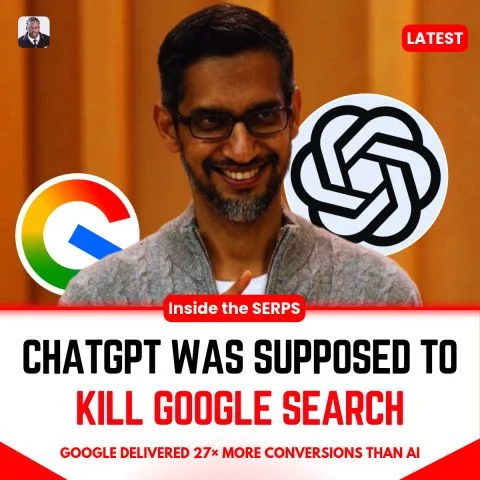
Marketers may be abandoning their biggest customer acquisition channel for one that barely sends traffic.
Over the past year, I've seen more marketers advocate shifting budgets from traditional SEO to Generative Engine Optimization (GEO).
The arguments are familiar: AI search is the future, ChatGPT visitors convert better, and brands need to prioritize AI visibility before competitors get ahead.
But what happens when we look at actual traffic and conversions rather than predictions?
A recent analysis by SEO expert Marie Haynes, published on October 21, 2026, raises some interesting questions about where businesses should invest their search marketing budgets.
ChatGPT Sends Just 0.62% as Much Traffic as Google
Haynes analyzed 12 months of Google Analytics 4 data from 100 websites, covering more than 145 million sessions.
Her findings were striking.
| Metric | Finding |
|---|---|
| Websites analyzed | 100 |
| Total sessions | 145 million+ |
| ChatGPT traffic relative to Google organic | 0.62% |
| All AI platforms relative to Google organic | 0.73% |
| ChatGPT conversion rate | 13.8% |
| Google organic conversion rate | 3.02% |
| Google's conversion advantage | 27× |
For every 1,000 organic sessions Google generated, ChatGPT contributed approximately six.
Including other AI platforms only increased that number to about seven.
This is particularly interesting given how much attention GEO and AI visibility have received recently.
We're seeing new AI visibility platforms, dedicated GEO agencies, and businesses considering substantial budget reallocations toward getting recommended in ChatGPT.
Yet in this dataset, Google was still responsible for overwhelmingly more referral traffic.
But ChatGPT Visitors Convert 4.5× Better
Here's where things get interesting.
Of the 100 websites analyzed, 55 were tracking conversions in GA4.
Across those websites, ChatGPT visitors converted at 13.8%, compared with 3.02% for Google organic visitors.
That's a conversion rate more than 4.5 times higher.
This supports one of the biggest arguments for investing in AI visibility: visitors arriving from AI assistants may be more qualified or further along in their buying journey.
Someone asking ChatGPT to recommend a specific software solution might already have narrowed down their requirements before visiting a company's website.
However, a higher conversion rate doesn't automatically translate into more customers.
Despite ChatGPT's impressive conversion rate, Google organic still generated 27 times more conversions than all AI platforms combined in the study.
And that's the distinction I think marketers need to pay attention to.
A channel converting at 13.8% sounds incredible. But if another channel brings in dramatically more visitors, it can still generate far more revenue.
Conversion rates mean little without considering traffic volume and total conversions.
Does This Mean GEO Is Overhyped?
Not necessarily.
I think there's an important difference between preparing for the future of search and prematurely abandoning what's working today.
AI search is changing how people discover products, evaluate businesses, and make purchasing decisions.
And AI visibility isn't necessarily limited to referral traffic.
For example, a potential customer could discover your SaaS product through ChatGPT, then search for your brand on Google before signing up.
In that situation, Google might receive the attribution even though ChatGPT influenced the discovery.
There's also Google's own AI ecosystem.
AI Overviews and AI Mode can influence which brands users discover, yet visits from these experiences generally fall under Google organic search reporting.
So measuring AI's entire impact solely through ChatGPT referral sessions would be incomplete.
But there's an equally important problem with the opposite argument.
Just because AI influences purchasing decisions doesn't mean every business should immediately divert its SEO budget into GEO.
Influence matters, but businesses still need evidence that their investment is generating meaningful commercial outcomes.
One Study Doesn't Represent the Entire Internet
There are limitations to Haynes' findings.
The dataset includes 100 websites of varying sizes, but the published analysis doesn't provide a detailed industry breakdown or standardized conversion definitions.
Only 55 websites tracked conversions. And different industries could experience very different results.
For example, a B2B SaaS company selling complex enterprise software might see greater commercial value from a relatively small number of AI referrals than a website relying on high-volume informational searches.
The results also don't establish how much AI-assisted discovery eventually becomes branded searches, direct visits, or offline conversions.
So I wouldn't use this study to conclude that GEO doesn't work.
I'd use it to question whether the current enthusiasm around GEO is always proportional to its measurable returns.
My Take: Don't Abandon SEO to Chase AI Visibility
I've seen marketers argue that businesses should move their budgets toward GEO because AI search represents the future of discovery.
The future may well belong to AI-assisted search.
But businesses have to acquire customers today, too.
My approach would be to prioritize three things:
Protect the acquisition channels already producing results. If Google organic is consistently driving qualified leads and sales, reducing that investment based on predictions alone makes little sense.
Build AI visibility alongside SEO. Understand where your brand appears in AI-generated recommendations, strengthen relevant content, and build credible third-party mentions without treating traditional SEO and GEO as completely separate disciplines.
Measure business outcomes, not just mentions. Being recommended in ChatGPT is encouraging, but the real questions are whether those recommendations influence qualified leads, pipeline, and revenue.
The right budget allocation will depend on your industry, audience, existing acquisition performance, and actual AI search contribution.
For some businesses, increasing investment in AI visibility may already make sense.
For others, the opportunity cost of shifting resources away from a proven SEO program could be substantial.
Final Thoughts
The biggest takeaway from this study isn't that ChatGPT sends very little traffic.
It's that a channel can convert significantly better and still contribute far fewer customers.
We should absolutely prepare for AI search. Businesses that ignore changing discovery behavior risk falling behind.
But replacing SEO with AI visibility before understanding the return on investment may be a dangerously premature bet.
The goal shouldn't be to choose between Google and AI.
It should be to capture demand wherever your customers are searching, without sacrificing the channels already generating business.
Would you move a significant portion of your SEO budget into AI visibility today?
Source: Marie Haynes, GEO Is a Distraction, October 21, 2026. Analysis of 12 months of GA4 data across 100 websites and more than 145 million sessions.